October 20, 2026
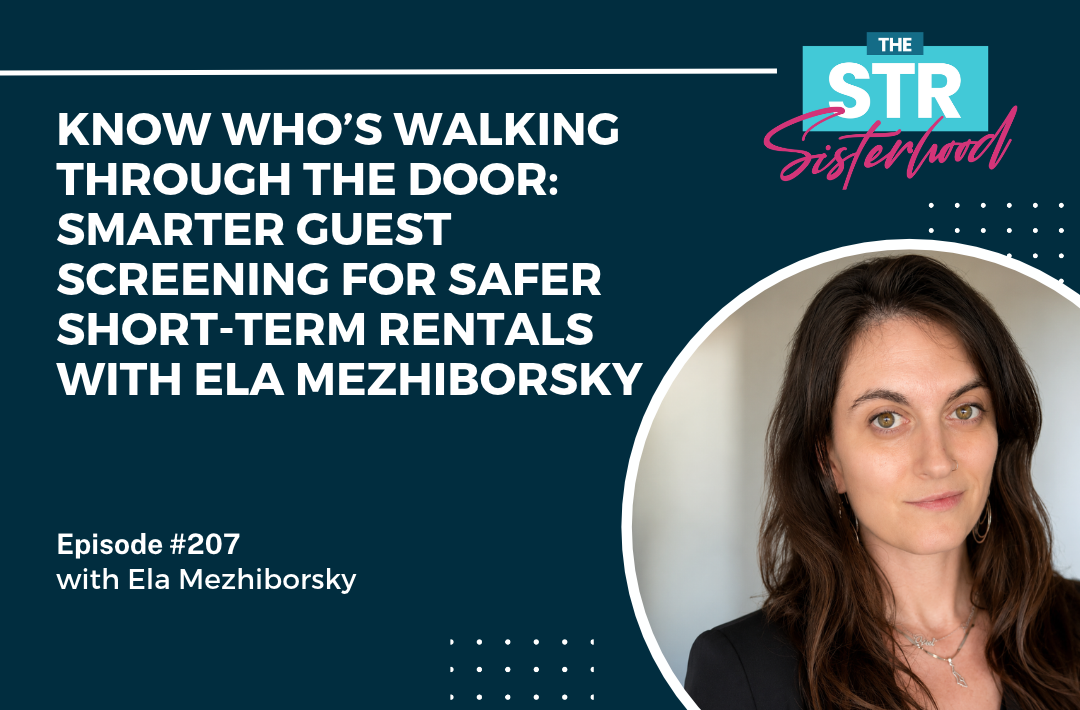
#207 Know Who’s Walking Through the Door: Smarter Guest Screening for Safer Short-Term Rentals with Ela Mezhiborsky
Do you really know who’s behind the reservation? Ela Mezhiborsky, co-founder of AutoHost and Checktiv, found out on Christmas Eve, when a Toronto police deputy called asking permission to raid one of her rentals. A known gang member was posting photos with automatic weapons from inside her unit, and her guest screening hadn’t caught it.
After that call, screening stopped being about parties and noise complaints. It became about knowing who you’re handing the door code to.
From Gut Instinct to a Guest Screening Decision Tree
Back in 2016, Ela was a short-term rental operator growing a property management company called Quick Stay.
As the guest support team grew, the gut feeling about who’s a “good guest” stopped being consistent from one agent to the next. So she drew a decision tree on the board.
Picture this. A 22-year-old couple books a four-bedroom condo for one night on a weekend. “It’s not an anniversary,” Ela said. But a warm, well-meaning agent says happy anniversary and approves it anyway.
Here’s what that’s really showing you.
If your guest screening lives in someone’s intuition, you don’t have a standard. You’ve got a mood.
Why “No Locals, No One-Nighters” Leaves Money on the Table
Ela called them the four main culprits: one-nighters, locals, Booking.com reservations, and weekend stays. A lot of operators just block all four.
“That’s a strategy,” she told me, “but it’s not necessarily a financially smart one.” Blanket rules feel safe. They also turn away good guests and real revenue.
Then COVID hit, and “no locals” became “only locals” if you wanted to survive. Rules built on assumptions break when the market moves. Clear criteria don’t.
When the Risks Became Much More Serious
The Toronto investigation traced back to a chain of reservations starting that September. Each one ended in a chargeback. Each chargeback got treated like a line item.
Once her team actually investigated, they saw the pattern. Targeted direct bookings, stolen credit cards, and people masking their identity online.
I know this one personally. A few years ago, a fraud ring found my direct booking site. Last-minute stays of two or three nights, then a fraud dispute two weeks later.
I submitted signed rental agreements and every guest message. I lost every dispute, about $15,000 in one summer. The local authorities in Myrtle Beach wouldn’t touch it.
Credit card fraud consistently tops the identity theft categories in the FTC’s Consumer Sentinel Network Data Book.
What Guest Screening Catches That Your Gut Can’t
Ela’s baseline is simple. “The bare minimum is to not make your stay a black box. If somebody’s trying to hide who they are, in reality, there’s a reason, and things are happening behind closed doors.”
Good guest screening compares data points you’d never catch by eye. A guest says they’re in Chicago, but their device pings from Bulgaria. Eight cards fail and the ninth goes through.
A booking site sees a card on file. Guest screening sees the pattern behind it.
Guest Screening Should Feel Like Check-In, Not a Bouncer at the Door
Most hosts worry that verification will scare off good guests. Ela’s answer: it’s table stakes now. Nobody complains when the airport checks their passport.
The guest uploads an ID, takes a selfie for a biometric match, agrees to the house rules, and puts a card on file for a deposit or damage waiver. Then they get their door code and guest guide.
It takes a few minutes, and it’s framed as a smoother check-in. And if someone cancels the moment you ask for ID? As Ela put it, “You’re up to no good.”
When Should Guests Complete Guest Screening?
Tie your reminders to the booking or to check-in. Don’t send them in the dead middle of a two-month gap.
Some operators ask within 72 hours, while the booking’s fresh. Others wait until a few hours before arrival, when urgency does the work, like checking in for a flight. For last-minute bookings, send a final notice the morning of check-in, then call.
What matters most is gatekeeping. If check-in instructions only release after verification, timing becomes a question of your risk tolerance, not your exposure.
AutoHost vs. Checktiv: Guest Screening for Operators of Every Size
AutoHost is the enterprise brain. It integrates with PMSs and guest apps, so a team processing a thousand guests a month only puts human eyes on the 27 that get flagged.
Checktiv exists because small operators pushed back. Ela got yelled at during conferences about unit minimums, and she agreed with them.
So Checktiv is pay as you go, with no integrations, no minimums, and no sales call. You send a link and verify the guest, even if you’re Airbnb-only or renting out a spare room.
Either way, you’ll see three statuses: pending, verified, or flagged for review. Neither platform cancels for you. If the name doesn’t match because a husband booked for his wife, you call, you override, you decide.
That’s the same principle behind smart STR business automation. Automate the routine. Keep humans on the exceptions.
Why Less Anonymity Means Better-Behaved Guests
One of AutoHost’s early clients, a large U.S. operator, had parties and gang activity across its Chicago properties.
Once guest screening went live, the problem bookings stopped. The gap closed, and they moved on.
Then the cleaners and maintenance team noticed something. Some guests were the same people, just better behaved.
“Stacey on a business trip is not Stacey on a bachelorette party,” Ela said. “The more anonymous it is, the more gray area you allow.” When your ID, card, and signed rules are on file, you turn the music down at 11 p.m., not 2 a.m.
She compared it to retailers who cut theft by putting up mirrors. Not because someone’s watching you. Because you see yourself.
Balancing Guest Screening with Privacy, Fairness, and Hospitality
Ela doesn’t pretend this is simple. She’s second-guessed false positives and misses, and she’s honest that “this person looks sketchy” usually hides bias about gender, color, orientation, or income.
So AutoHost now blurs guest photos, so support teams only look when they truly need to. And collecting IDs by email or writing card numbers on paper in a drawer? In 2026, Ela’s clear: that’s a privacy problem, not a system.
Here’s the leadership question for you.
Is your guest screening built on objective data, or on who you expected to see? Only one of those actually protects your business.
Do You Actually Know Who’s Walking Through the Door?
The goal isn’t to treat every guest like a potential problem. Most guests are wonderful.
But responsible hospitality means creating systems that protect the people, property, and community entrusted to you, without relying on assumptions about who someone appears to be. It sits right alongside the right short-term rental insurance in how you protect what you’ve built.
So ask yourself: if a fraud ring found your direct booking site tomorrow, what would stop them?
Listen to my full conversation with Ela on The STR Sisterhood Podcast. Then bring your guest screening rules into the STR Sisterhood and pressure-test them with women who run this business every day.
Click here now to listen to the full podcast.
HIGHLIGHTS AND KEY POINTS:
[00:44] A short introduction about our guest Ela Mezhiborsky, her background as a short-term rental operator turned startup founder, and her work with AutoHost and Checktiv
[01:39] Ela shares how challenges inside her property management company led her team to move beyond gut instinct and create a more standardized approach to guest screening
[07:21] I share my own experience being targeted by a fraud ring through direct bookings and losing approximately $15,000 in chargebacks during one summer
[09:37] Ela explains what hosts can do to protect themselves from fraudulent reservations, including identity verification, payment checks, and knowing who is actually booking
[11:56] Why hosts shouldn’t be afraid that identity verification will create too much friction for legitimate guests, and how screening can become part of a smooth check-in experience
[13:31] Ela explains how her property management company standardized guest screening instead of relying on gut instinct
[14:49] Ela walks through what the guest verification process looks like, from uploading an ID and biometric verification to house rules, credit cards, deposits, and backend checks
[17:31] The difference between AutoHost and Checktiv, and why Checktiv was created to make professional guest screening more accessible to smaller operators
[21:07] Best practices for when guests should complete verification, including how hosts can approach last-minute reservations, reminders, deadlines, and access to check-in instructions
[25:10] How hosts can monitor the verification process, understand pending, verified, or flagged reservations, and use the information provided to make their own final decisions
[27:04] Ela shares a real-world example of how guest screening helped reduce problematic bookings and unexpectedly encouraged better behavior by creating greater accountability
[31:48] Ela reflects on becoming a SaaS founder and why firsthand experience with a problem can make someone uniquely equipped to build a solution for the industry
[33:56] Ela shares where her drive to solve problems comes from, the role of critical thinking in her life, and the experiences that pushed her to take guest screening further
[39:21] Ela talks about second-guessing decisions, learning from false positives, reducing bias and discrimination, and making sure the company continues to operate according to its values
[42:36] Ela shares how she approaches fear, change, and stepping outside her comfort zone—and how she distinguishes between fear that comes with growth and a gut feeling that something is wrong
[44:38] The lightning round
Golden Nuggets:
- “The bare minimum is to not make your stay a black box. If somebody’s trying to hide who they are, in reality, there’s a reason, and things are happening behind closed doors.”
- “The more anonymous it is, the more gray area you allow.”
- “You need to be the one experiencing a problem to be the best person to solve it.”
- “Most guests are amazing and you just need to know who’s walking through the door.”
- “Networking is not the exchange of business cards, but it’s actually getting to know people and building friendships.”
- “You either succeed or you learn.”
Connect With Our Guest:
Websites : https://www.autohost.ai/ https://checktiv.com/ LinkedIn : https://www.linkedin.com/in/elamezhiborsky/ Instagram : https://www.instagram.com/p/Dd6-fGmo3PK/
Full Episode Transcript:
Good, good. All right. Here we go. So today we are joined by Ela Mezhiborsky and we are so excited to have you with us. Thank you so much for being here.
Thank you for having me. This is exciting.
So first of all, I would love to kick off and have you share with our audience a little bit about who you are and what you do.
All right. So I am an ex-operator turned startup founder, and pretty much very much focused on solving some problems in the space that we experienced and then realized that bigger and better players than us are experiencing. That was quite a while ago. So yeah, I’m the COO of AutoHost and our new platform, Checktiv, and we are in the space of guest screening. So we handle things like ID verification, fraud prevention, chargebacks, the fun stuff. All the fun stuff.
So take us back to the beginning when you were operating. How were these challenges showing up for you? And where did you notice that there was a gap in the market?
So this goes back to like 2016. So we were ramping up my property management company at the time was called Quick Stay. And what we hit was as we were growing, we hit this sort of a almost a benchmark where our guest support team became so diverse that the gut feeling of what’s a good guest, what’s a bad guest, how to screen, how to do your judgment call was no longer intuitive. And we came to this point where we’re so focused on guest experience and giving the best guest experience possible. And then suddenly you kind of like blindsided by bad guests and bad apples, which is so unfortunate and so demotivating because we’re in a beautiful space and we want to be running hospitality. And we kind of came across the gray area of risk, like parties, vandalism, rule compliance, smoking. And you kind of get into the whole, how can we tell in advance whether a guest is going to be doing that? So we kind of started at some point. Introducing some internal measures. Just, I mean, I drew a decision tree on our board. And again, you know, if it’s, you know, you have your four main culprits, you have your one-nighters, your locals, your Booking.coms, and your, say, like, you know, weekend reservations. That I found a lot of operators, like the solution was, let’s just go better safe than sorry. So we don’t accept them. We don’t accept locals. We don’t accept one-nighters. We don’t do Booking.com. And I’m like, that’s, I mean, that’s a strategy, but it’s not necessarily a financially smart one. And I’m like, we’re losing, we’re leaving a lot of money on the table. Can we somehow tweak and fine tune? You know, we could accept them, but we need to be a little bit more rigorous in our screening. So we started introducing these sort of like some parameters and criteria that our team was asking to determine how risky the guest is likely to be. Some basics like length of stay, people. If a couple is booking a four bedroom condo for one night on a weekend and they’re twenty two, it’s not an anniversary. But when you have guest support agents that are like, oh, my God, happy anniversary and bless your heart, but no. And so it kind of led to us standardizing internally. And then once we saw that the structure works, we kind of we automated it. So at the time we were joined by so now my co-founder and AutoHost CEO, Roy Fierstein. So he’s a good childhood friend and he comes from the cybersecurity space. So Roy came in and really helped. Once we saw the need for it, we came and automated the product. And then jumping ahead a little bit, we unfortunately were hit with. Next level. So we’re talking gray area fraud, but then we kind of, you know, the dramatic moment that we received a phone call from a Toronto deputy police on Christmas Eve telling us that they have a confirmed sighting of a known gang member posting on Instagram with automatic weapons in one of our properties asking for our permission to raid the place. We gave her permission and that launched an investigation with Toronto police. Now, the beautiful thing is that at the time we had AutoHost 1.0 point already running for basic stuff. And because Roy comes from cybersecurity, we were also monitoring things like device fingerprinting. And are they hiding behind a VPN? They’re trying to mask their identity online. And we kind of came to the point that, hey, This is actually a result of a chain of reservations going back to September that year that resulted in chargebacks. Now, a chargeback, but you don’t investigate into it. It’s like a line item that you just accept. But when we started investigating, we’re able to correlate them and see that this was meticulous. Like this was they were targeting our properties, direct bookings, by the way. And we thought even worse. We thought that we have a guest screening process, but we were focused on parties. We weren’t focusing on real fraud. And so that was a kind of a wake up moment or a slap in the face, whichever, wherever you are on that spectrum. And we kind of said, okay, like, you know, Roy comes from cybersecurity. It goes way beyond just help us automate something. This is serious. This is bigger than us. And, you know, we’re running about a hundred properties. Some operators are running hundreds and thousands. And that’s kind of what led to AutoHost became this internal brain of ours for screening and vetting to the next level. So starting to look at actual IDs and are people lying about their identity? And does the credit card go through? Is it a stolen credit card? Did they upload eight that failed and then the ninth one went through? So all of these things, we kind of started automating for internal operations. And then around the time COVID hit, we realized that players bigger and better than us need this yesterday. Also, COVID changed the game. So your rule of no locals, now it’s like only locals if you’re going to survive financially. And so many of these things, you had to become a lot more objective. And the companies that were getting ready to like accelerate out of COVID and they were re-evaluating their tech stack was kind of our launching pad at the time. To really help solve a big problem. And then the dramatic part, I unfortunately, or fortunately had to during COVID kind of wind off Quick Stay. So the property management company, and we really transitioned our focus a hundred percent to AutoHost and now Checktiv. And so that’s kind of the, here we are today.
That is wow. What a journey. Thank you for walking us through that. I want to go back to the whole discussion about chargebacks because I have experienced this in not a fun way. I mean, gosh, I’m trying to think of how many years ago it was, but probably I’m going to say three to four years ago, maybe. I got discovered. I feel like when you say that, it’s so exciting. I’ve been discovered, but I was discovered by a band of frauds. And what they would do is they would book our properties direct. They would come and stay in the… And they would all be last minute bookings. They would come and stay in the property. And they were usually like a two to three day booking. Okay. And then two weeks later, we would get a charge back saying it was a fraudulent charge. Now we… Did everything by the books at the time you know we submitted our signed rental agreement we submitted all of the conversation with the guests to show that they were there we lost every one of those chargeback disputes one summer alone it was to the tune of fifteen thousand dollars like it was a lot and I contacted the local authorities in Myrtle Beach, South Carolina, where this occurred. And they didn’t want to touch it with a ten-foot pole. And I was blown away. I was like, how is it that you don’t want to investigate this? This is fraud. Like, if they’re doing it to me, they’re doing it to other people. And they said, oh, this is an online purchase. So you need to go to your local authority. I happen to live in Ohio. Well, that’s ten hours away. I had an officer come out to my office and he’s like, listen, ma’am, we’re not going to touch this with a ten-foot pole. We don’t want to have anything to do with this fraud ring in South Carolina. And Ela, like, I’m still to this day distraught about the fact that these people are getting away with this. What can hosts do right now to protect themselves from this happening? Talk to me about that.
Okay. So, I mean, the whole spectrum of guest screening is exactly why this is in place. So let’s still go, like, I mean, what’s a fraudulent reservation? What’s a chargeback? A chargeback is not Stacey and her girlfriend want to stay in town, but don’t feel like paying out of pocket. So let’s use a stolen credit card, right? A fraudulent reservation means that there was also some anywhere between sketchy to criminal activity going behind it, which also means that these are the people that will either refuse or fail to go through a proper, very respectful, but screening and identity verification. Whereas a legitimate guest, especially these days, you’re talking three, four years ago, but a lot has changed where screening became table stakes. I mean, you might go into a hotel and be surprised or a short-term rental and be surprised that they didn’t ask for your ID. What if your account was stolen? What if your identity was compromised? Why are you not making sure that I am me? And so these days on the operator side, the very least you can do and should be doing is really just making sure the identities are validated and then you go to the next level. So, I mean, credit card needs to be on file, whether it’s Airbnb or not for your deposit. You can compare whether it’s manually or with tools that are there, compare lots of data points, making sure that they exist. If somebody is telling you they’re in Chicago, but they’re pinging in Bulgaria, then that’s something that you wouldn’t know as a guest support agent, but the tools can really ping for you. AI is making it a little more complicated, but at the end of the day, the bare minimum is to not make your stay be a black box. If somebody’s trying to hide who they are in reality, there’s a reason. And things are happening behind closed doors because those chargebacks, by the way, you also don’t know what happened inside. You’re saying like, you know, it’s a fraud gang. Sure. But were they watching Netflix? Probably not. So now we’re getting into the things that are happening inside are also kind of on your legal, moral, ethical responsibility. So black box in hospitality should not be the case. We don’t these are not the, you know, high profile crazy celebrities that can, you know, have their identity taken. So just know who’s coming through the door.
Right. And I think A lot of hosts and I’m curious to get your perspective on this. I think a lot of hosts have this concern that, oh, if I have my guests go through an identity verification, they’re going to cancel. They’re going to not want to stay with me. What say you?
So great point. I heard that a lot years ago. Again, I would say that right now it’s table stakes, so it’s not even as relevant. So right now, most of us have been guests. You go through that process. If anything, it’s really set up as a guest experience flow because you’re going to submit everything in advance so that you get your door lock code, so that you get the guest guide. So if anything, there’s the element of removing friction from booking is by you going through all of these steps and not waiting either at the hotel lobby or for somebody to meet you if we’re talking short-term rentals. So the friction really isn’t there. Now, generally speaking, to avoid friction on, say, booking sites or direct, the process would normally have it be that the booking is made and there’s always fine print that, you know, this is conditional upon when you get your ID on file and stuff. And so the verification happens afterwards. If you just booked a place and you got a beautifully designed guest portal, goes, hi, Stacey, we are so excited to have you. You’re just confirmed your stay is from, you know, May twenty seventh to twenty ninth. And it’s two guests. Please upload your ID on that. If you cancel after receiving it. You’re up to no good.
Yeah. Yeah. Yeah. What also would you say to a short-term rental host that is concerned about getting bad reviews because of having an identity verification process in place?
So again, these days, because it’s almost like you’re not going to complain at the airport that they checked your passport, even though you look trustworthy. So it’s no longer a question. So again, there’s a way to, you’re not a bouncer at the door. We’re in hospitality. This is about guest experience. So still, everything is very much presented on the front end as a smooth check-in process. Right. And there’s always ways to explain that the process is to protect, to mutually protect us. We need to make sure that your identity hasn’t been compromised, that your credit card hasn’t been stolen, that you are who you say you are. We’re protecting the neighborhood and the city. And so we want to make sure that guests that are coming to stay are good guests. We’re in the space of hospitality and vice versa. You as a guest these days, you want to make sure the guests get vetted and this is a responsible operation. Not to mention that to grow a portfolio, you want to prove responsible operation and inventory providers want to know that you know who’s walking through the door and that you’re doing the responsible thing.
Yeah, absolutely. Absolutely. So walk me through the process of an average host who’s utilizing a service like AutoHost or Checktiv. And I’d love to, in a moment, dive through the differences between the two. But what does that identity verification process look like?
Okay. So the, the core of it is you upload your ID as the bare minimum. And we always do a biometric scan, which is a selfie. And we compare that, you know, the person holding the ID is the person on the ID. We also have a, you know, you can do like a movement wise. So we’re getting more advanced as AI can fake things. We’re getting a lot more advanced with AI to spot them as well. But at the end of the day, it’s a guest journey. So, through platforms or through your own guest journey you’d go from hi Stacey thank you for booking please follow this to confirm your reservation and you’ll verify a few things I mean these are my dates and who’s staying and please provide the guest names and agree to the house rules and please upload your ID and credit card on file either for a security deposit or you know a damage waiver for those that are relevant, you can have your house rules, you can have your unique screening, like, you know, in the properties with a pool, you want an extra rule to not pee in the pool. So everybody really can have their own process flow. But at the end of the day, it’s a few minutes of a check-in process that guests can do in advance so that they get, thank you so much, you’re good to go. On the back end, you as the operator will either get a, everything’s good, guest is verified, which means really that to the best of our knowledge, given all the factors that were examined, both from what was provided and on the back end, because we check social profiles and watch lists. We can run background checks. There’s a lot you can do. And if nothing was flagged, then you still get the green light. Does it mean the guest won’t spill something on the carpet? Not necessarily, but to the best of our knowledge, both for gray area risk and real criminal activity, it’s been vetted as much as you can, and you can sleep better at night.
Right, right. And how long does it typically take for that green light to come back? Is that five minutes, five days, five hours? What does that look like?
So it’s instant. So everything’s calculated on the back end. I mean, if background checks or credit checks are run, I believe it could take up to like three or four minutes. But it’s practically there. And then people have their, again, depending on level of tech and automation, some people will just look at the green or red light and then make their decision on how to proceed. Some will have automation. If it’s a green light, release the check-in instructions or the door lock code. But if it’s not, pause it for manual review. It’s kind of where you can get as fancy as you’d like or as simple as you want.
Gotcha, gotcha, I love that. Now talk to me about the difference between AutoHost and Checktiv. What does that look like?
Okay, so Checktiv is our newest kind of parallel platform that we kind of have launched, are launching. So it is live, we have some early, users on it and we’re extremely excited. But so, AutoHost is the classic platform we ran with. It’s the brain behind screening. We are integrated into all the PMSs out there. We then went to a higher level of being embedded into some PMSs, into some guest apps. And so it was really working with large operators where scale and automation was a big part of the process. So if you’re processing a thousand guests in a month, instead of your team looking through a thousand, Even assuming that, you know, avoiding the human error gaps, but looking through a thousand guests and making a judgment call, the automation process was really, okay, nine hundred and, you know, seventy three of them are good to go. We need human eyes on these twenty seven. So that was the previous, not the previous, the classic AutoHost flow and larger teams really rely on AutoHost and your whole screening process and it’s mapped out there and you talk to sales and you go through onboarding and we’re extremely proud of it. And that’s, you know, that’s my baby. However, we have gotten this constant understanding that the smaller population are targeted by both gray area and real fraud and criminal activity just as much, if not more, because they don’t have the measures in place. And Checktiv was really born as this… We took everything and all the expertise behind the AutoHost and said, why not give everyone these superpowers? So this is really a, there’s no integrations required. There’s no tech, there’s no talking to sales. It’s very much pay as you go, no commitment. You just hop in, you send the link and you verify the guest. So we removed the gatekeeping from it. And it’s really like we figured that it’s the opportunity to completely democratize like the whole guest screening game so that it’s easy for like everyone can get the same level of confidence as the big players do.
Right. Even if they’re let’s say we’ve got folks who are only on Airbnb that, you know, don’t have a direct booking website, that don’t have Vrbo. Would you still say that Checktiv is a good, viable solution for them?
A hundred percent. And that’s kind of why it was born. So we’ve had, man, I was yelled at by small operators and conferences of like, why do you have a minimum units? Or why do you have, like, this is not fair. Screening should be available for everyone. So a hundred percent. And even with Airbnb, I mean, Airbnb does an initial supposed screening when somebody opens an account and it’s, you know, a lot more reliable than just picking up somebody from the street. But then again, from the operator perspective, it is your responsibility to make sure your property is safe. And Airbnb has in the rules that, you know, if you’re contractually obligated, so let’s say your property, like owner or whoever, like it’s in your contract that you need to be collecting this for lack of anonymity, then yes, even somebody who’s just on Airbnb or… We can go as far as Ela’s renting out her second bedroom, but I want to make sure that I have on file the right information about a guest. And it’s 2026. You can’t just ask for an ID to be emailed or get somebody’s credit card and write on a piece of paper and put it in the drawer. That’s personal identifiable information. That’s privacy concerns. You don’t do that. So that’s kind of really where Checktiv comes to save the day. And you don’t need to be a big player. You don’t need a minimum number of properties. You don’t need it. A PMS to be feeding things into it, you can just go ahead and use it with zero minimums or limits.
And so what is the, the recommendation on timing? And the reason why I ask is we have situations and we actually, for our direct booking website, we don’t allow last minute bookings on our direct booking website now though. I could now, right? Because of what we discovered, a lot of the last minute bookings were the ones that we were having troubles with chargebacks. So let’s say a guest books and it’s Thursday and they’re checking in on Friday. What is your recommendation if they get the email right away that says, please verify your identity and they don’t? When do you start pinging that guest? What is your, you know, your best practice recommendation? When do you start pinging that guest? We’ve actually canceled on behalf of our direct booking guests who don’t ever fill out the information because obviously we message them multiple times, letting them know how important it is. But what is that? Window look like when you make that call? Hey, I’m going to cancel this guest because they’re not completing the verification.
So, I mean, obviously it depends, but it depends on a few very important things. The example you gave is actually not as don’t have as much flexibility because you’re describing a case where they booked last minute so they’re not filling it out then theoretically you can give a window you can make sure it’s a few hours later you can make sure it’s the morning of check-in to say last notice you really need to complete this so that you can access the property so in those cases it’s really a matter of where your standards of practice and operation are to know what is considered safe or not smaller operators your rule can really be if they didn’t complete it by the morning of we’re going to have one of our guest support agents call them some people will just go ahead and cancel I think the bigger question happens when the booking is made two weeks or two months before the state and we’ve had I’ve seen everything on the spectrum I’ve seen properties where because they don’t want to lose momentum as soon as the booking is made even if it’s for the summer they give them seventy two hours because it’s fresh you just booked it go ahead and complete it and you’re good to go. Some say we can have a lot of turnover, we can move people from property to property, we’re not gonna lose money if the reservation gets canceled, and they’re happy to wait till four hours before check-in. And that’s when they start sending the urgent reminders. So best practices would be either tied to booking or to check-in. So I mean, if there’s two months of a gap, don’t send it in the middle, because there’s no urgent there. So that’s probably the best practice. And then it’s really a matter of your risk tolerance. So in places that can be more flexible, You can wait closer to check in because the urgency is there. People check in just like, you know, you know that a day before the flight, you should check into your flight. If you suddenly get a reminder from, you know, your property manager saying, by the way, your stay is coming up. We still need this filled out. They’re more likely to go, oh, yeah, let’s just do it. Let’s just go ahead and do it. Again, the good guests. The problematic guests is where it’s also very powerful because they will either refuse to do it or fail. And by fail, I mean something will get flagged on the ID submitted. The credit card won’t match something. We will recognize something about the device having been flagged in the past. We will see something like they tried Seventeen different credit cards that are reported stolen, but the eighteenth one goes through. Booking.com, for example, or any other site will let that go because, okay, now we have a credit card on file. We will obviously not. So if something gets flagged, the timing also doesn’t matter as much as long as you’re gatekeeping the check-in instructions. And as long as your ability to check in is conditional upon, you need to go through a verification, confirm you are who you say you are, present it nicely to the guest, then the timing is really a matter of your tolerance to last minute changes.
Love that. Okay. And so let’s talk about the logistics of this. Let’s say again, you’ve got an Airbnb window open on Google Chrome, you’ve got Vrbo open, you’ve got your property management software open. I’m assuming these messages asking guests to verify their identity are all set up through automations. What does the host then do to know, okay, did this pass, you know, AutoHost or Checktiv’s inspection, shall we say, or did it fail and reveal that there were problems. So do they just have a portal that they go to? How does that work?
Correct. So you do have an owner or an operator host profile and portal that you will see all of your guests. Again, whether you’re using AutoHost to all the advanced functionality or you’re on Checktiv and you just came in for the specific reservations you want, you send the link, but you will have the specific guest that was being screened. You will see the status of the verification. So either it still pending, it was verified, or it was flagged for review. Those are the three statuses we will do. We will never cancel a reservation on your behalf. That’s not the point. We are there to kind of be the hundred X to go beyond your intuition, gut feeling to really verify the objective data points. So, yes, you will see either verified or flagged for review. If something is flagged for review, we will share a list of the elements that were problematic. So the face didn’t match. The ID was expired. Sometimes you’ll have something like the name didn’t match and your risk tolerance could say, oh, you know, it’s a person that’s using a different name or a husband booked for a wife. I call them. I’m OK with it. You can go ahead and approve and override. We will not do anything different. To stop something from happening. We’re just there to be your kind of voice of reason and responsibility beyond what the human naked eye can see.
Yeah, yeah. So talk to us about what this looks in real life. I am confident you’ve probably heard hundreds of stories of what this has done to help hosts. Share one that might be helpful for our audience to know about.
Oh, there have been a lot. So I like, here’s one that I really like. So this was a very early, early client, big operator in the US, actually very big. So they did a lot to help with product roadmap and their feedback was huge for the development. But at the time, across the different cities, they had specifically a lot of parties with gray area touching on criminal activity in the Chicago area. And so it was anything from local gangs, some drugs, some, I don’t think there was escort services on that side of things, but it was pretty much like gangs, parties, activities, drugs. They had some rules around no local bookings. So somebody had their cousin from LA book and then they checked it. So And it was the issue. And the people that felt it the most wasn’t even around the chargebacks. It was really the state of the properties. So it was a lot of Airbnb bookings. So at the time, by the way, now Airbnb holds the right to. Push the charge back onto you. In the past, that wasn’t the case. So let’s say in the past, your payment is guaranteed, but the state of your property and the happiness level of your neighbors isn’t. So it was really a problem of the on the ground operations. So it was like boots in the grounds, the people, they were both the cleaners and the maintenance and the people that were in charge on the ground, they were the main ones feeling the frustration there. And then, I mean, something really happens, the next guest can check in. So it was causing a lot of friction. They implemented AutoHost for their entire kind of guest journey flow. And what was interesting feedback, it wasn’t so much that we prevented reservations from going through. Some were caught and they just stopped booking. So that was also that. It’s not that AutoHost, at the beginning, we caught some things, but then they stopped booking. So it was almost like kind of what you said, when certain gangs are criminals, like these are not AI bots, right? Like gang notices that, you know, this specific property management company has a gap. They have a weak spot. They start exploiting it. So they kind of said that once it was brought in, they stopped booking, which was beautiful. That was step number one. And step number two, the guys on the ground kind of said, they asked to hop on a call with us and kind of really, really share the feedback. And they said, sometimes it’s the same guests, but they’re better behaved. At the end of the day… Stacey on a business trip is not Stacey on a bachelorette party. And it’s the same person. It’s not fraud. It’s your real ID. But the more anonymous it is, the more gray area you allow. And so even in cases where people are booking properties to enjoy their evening, your ID is on file. Your credit card is there. There’s a security deposit. You sign rules and agreements. Everything is documented. You are a lot more liable for your stay. You’re going to turn off the volume at eleven p.m., not at two a.m. And these types of things were also really great to discover because it’s like everything gets shifted to a little bit better when there’s lack of anonymity. Like the best the best comparison I found was interesting. I don’t know if you ever heard this in retail. This was years ago. They discovered that putting mirrors in retail stores dropped theft by like an insane percentage. And the reason wasn’t because you’re afraid that through the mirror somebody sees you is because you see yourself. It’s not liable. It’s the being watched. And it’s like, you know, you think you’re a good person. You don’t want to watch yourself shoplift. So it’s kind of the same structure. It was really fascinating to see that, yes, fraud stopped or reduced and so on. But even the same guests are better behaved. It was like a really unexpected but amazing kind of outcome of that.
Wow, that is really cool. That is really cool. And I could totally envision why that’s the case. Like hearing you walk us through that, I’m like, well, of course, you know, if they know that this operator or owner or host, whoever is on the back end receiving their information knows who they are. And they’re going to be potentially penalized if they do act up. That’s a much different story. I’m curious from your vantage point, looking back to, again, the very beginning, did you ever dream of having a software company? And is that how you would describe yourself as a software company? Let me ask you that.
I mean, now, absolutely. We are a SaaS platform. Did I dream about having a software company? Whew. No, I think that the draw to hospitality was a lot bigger than my draw to software. And I generally think that people starting companies, and this is not unique to us, at the end of the day, you need to be the one experiencing a problem to be the best person to solve it. With any startup, there’s a whole why this, why now, and why you. And I always think that no matter how big and great entrepreneurs can be, you can never look at a group that you’re not part of from the side and say, ooh, this is their problem and I know how to fix it. Like, there’s nuances that you feel as an operator. Like, to the specifics of… When somebody, let’s call it sketchy, was trying to book and distract the guest support agent, there were things like, they would ask questions like, are the pillows down or synthetic? Instead of answering the question of, can you please be any extra guests? They would shift the conversation. And it’s these types of nuances that we’ve gone through that kind of made us see it. So I feel like my heart and soul is completely still in hospitality. And dealing with the beautiful side of it. So I almost, I mean, I would say fell into the software side, but it makes me feel really good because we can solve this problem, not just for us at the time, but across the industry. And again, we’ve been operating for a while. So these last couple of years, the idea of guest screening and verification has really gone from, ooh, nice to have, and the big players are doing it, to complete table stakes. Your PMS should have it. Turn it on. Your guest app should have the ability to validate a check ID. Make sure to enable that. So we’ve gone a long way.
That’s phenomenal. Okay. I want to shift gears for just a minute and I want to ask you about you, about Ela, because I will tell you a lot of people, okay, experience challenging things and they never set out to solve it. They just experience them as challenging and they just accept them as challenging and So I’m curious where that drive comes from. Did you grow up around entrepreneurial parents? Were you exposed to entrepreneurs? Where did that come from?
Great question. So no about entrepreneurial parents, but probably yes about a lot of, so just critical thinking and challenging things everything and a lot of debate. So I come from the world of mathematics. A lot of influence from my dad, for example, just to kind of think critically and do those things. But when it comes to entrepreneurship and solving the problem, I think it’s a mix of the why this, why now, why you, there is an element of a little bit of responsibility. And it was a mix of, first of all, I did work with a genius co-founder and Roy comes from the world of tech. So the idea of, well, if we can do it for one company, let’s scale it, was a lot of the drive for a bigger vision. And then from hospitality, I think that as soon as I understood that the problem solving is not so much, oh, you got to charge back, let me help you save money. But a lot of things are happening. So the beauty of it, and there’s bad apples that are ruining it, and a lot of companies are dealing with it. In my case, it was a journey, but I feel like there was this one pivotal point for me that as a woman founder, goes beyond you know the incidents that I mentioned with the automatic weapons is terrifying and that definitely launched something but we had a parallel incident where we basically identified one lovely day that an electricity bill from a specific property came in like 4x, through the roof and we narrowed down, we opened it up and we saw that the entire bump came from this like four or five day reservation. We go back to our files and we go back to, and we had AutoHost version 1.0 running at the time with not as much backend checking, not even ID verification, but the basics agree to the rules. Make sure you do this. And we narrowed down, we saw the reservation. It looked supposedly fine on paper. The guests weren’t really very communicative, but I mean, it went through, there was no chargeback from that one. And yeah, At the time, we kind of look back at the reports. The cleaners did did report that, you know, it was kind of a bit of a mess, but nothing that made us go investigate. But narrowing it down, trying to look at the identities that we’ve identified, which weren’t right, the point of the investigation resulted in a crazy revelation where this was a part of a condo building. And so it turned out that A local gang had rented about, I think, ten to fifteen properties in that whole building to run escort services. And our property, our unit was used for laundry twenty four seven.
Oh, my gosh. Wow. To make the connection. Is insanity. And so, again, this was an early trigger of taking AutoHost to the next level, but then there’s the, you know, we sit there with our team and everybody’s pumped and we’re like, this is horrible, let’s solve it. But then we go home and I go to sleep and I’m like, girls were being exploited in my unit or like I caused something. Yeah. And the payment went through. So does that mean I’m okay with it? You know, like, and I feel so this sort of a responsibility. Passion to this is not okay is a lot more of a driving source than, you know, let’s help an operator avoid a chargeback as much as business perspective. That’s really important. Right. So it’s really the mix of these two. And I was lucky enough to work with really, really smart people in the product and tech side. And it was really cybersecurity and hospitality meet to bring expertise that we don’t have in the space. And the opportunity was there. And then honestly, another catalyst was really COVID where players that are, you know, bigger and better than us knew how to work things out. They had the budget to survive that storm and accelerate out of it. And it really gave us an opportunity to say, are we going to keep, you know, AutoHost as just the brain behind quick stay or, sense to be a standalone and we can solve a much bigger problem on a larger scale. And that was appealing from both a complete business strategic growth perspective, as well as this is how we can make more of an impact on an industry.
And after you decided to scale it and go bigger and help more people, did you ever experience a time where you second guessed yourself? And how did you get through that?
I mean, Monday, like, like, yesterday, Stacey, all the time. It’s a big question. I think. You know what? I mean, lots all the time with everything in life, but I guess if we make it a little bit more, you know, more specific, I feel like there’s been times when we were challenged to, again, it’s the stories behind verifications that, that ended up touching us. And so. Second guessing would be, let’s say, in a situation where our screening resulted like a flag, but let’s say it was a false positive and, you know, the guest experienced something they shouldn’t have or vice versa. Like we resulted everything correct, but, you know, digging into, say, non-official court records, but just Google searches actually revealed that this person did have some, they were on the news for something and we didn’t flag it. We did afterwards and that went into like roadmap. But I feel like there was this constant, are we doing what we’re standing behind? There’s also a big element of removing bias and discrimination because we kind of felt like in hospitality, the small operators, it feels really comfortable to kind of say, well, gut feeling is this person looks sketchy. But if you dive into what sketchy means, you get into a lot of characteristics that are biased. And so at the end of the day, gender, color, orientation, or even socioeconomic status shouldn’t be an indicator as long as payment goes through, you’re a good guest, your intentions are good. And that was a little bit second guessing on things like, are we standing behind our principles of removing discriminations? One example was that when you collect ID and then you take a selfie, the operator on the back end can see. Our judgment. So something that came through, again, some large players with their social responsibility practices in place, they helped us come to the conclusion that we should be blurring the pictures. So if you need to, go ahead and look at it. But for every operator that sits there, for your entire guest support team, there’s still an element of privacy. And most guests are fantastic guests. Don’t forget that this is not just like, let’s catch criminals. Right. Like most guests are amazing and you just need to know who’s walking through the door. You need to have them on file. You can, they can become direct clients afterwards. So it was really just like finding that balance of, are we, you know following our own principles and there’s been great debates even with the team and whenever these types of big features come in we we bring it up to debate with everybody I mean the guests I’m sorry on our end like the success team the onboarding or tech people such as we have our values, we have our guiding principles, and we’re like, does that align with them? And there’s been times when somebody challenged us and said, well, sure, this might, you know, this feature might bring in money, but does that, like, aren’t we now doing what we said we won’t do? So some great debates came out of that. So that’s more product second guessing. And otherwise, I mean, you know.
What about when you go to bed at night or you get up in the morning? Do you ever wake up and feel fear? Maybe not recognizing like, oh, I’m scared of something, but maybe doing something outside of your comfort zone. And how do you push through that?
Yeah. So yes, not often. And probably a lot more in, I can’t say personal life. My personal life and my career are kind of very much intertwined. It’s not so much that I balance, but it’s more the cohesion of it. Any change is scary. So I mean, even… I also have two kids. I’m scared about everything, right? In the morning, sometimes with feet in my face. Right, right. I’m gonna break my nose. But there’s, you know, like product has gone through pivots. I have, I personally have gone through so many things I went from, you know, focusing on product or customer onboarding back in the day, handling finance, doing other things to really coming and saying, there’s so much, for example, to advocate for. So, I mean, really hopping on podcasts was something that I woke up scary about, right? Me going on stage and coming and saying that, you know, this is something we stand behind or walking into a room and networking or understanding that networking is not the exchange of business cards, but it’s actually getting to know people and building friendships. That didn’t come natural to me. I’m scared of every transition, but I think there’s something about, you know, you kind of then assess what element is fear and what element, you know, what percentage is excitement. And as long as you’re good with, I mean, is it really fear? Is a lot of excitement? Then you go and do it. Right. And if it’s not, by the way, that’s also like a valid thing. I’m like, my gut is not there. And like my, my heart isn’t in it. And oftentimes I would probably try to get myself to change course. And if I don’t, then I will recognize that I’m depressed about it a few days and weeks afterwards and something wasn’t right. So kind of reset.
Yes love it all right I want to move to the lightning round okay so I’m gonna ask you some questions and I’m just gonna have you answer with the very first thing that comes to mind first question where is your favorite place to vacation
Oh my God, a lake. Any lake. Any lake. I need like water and green around it.
So controversial, but I’m not a beach person. What? I thought I liked you. I’ll go to a beach.
I’ll go to a beach, but I prefer a lake. So I will prefer like not salt water and sand. I would prefer trees and put my head in.
There you go. There you go. Okay. At sunset. At sunset. All right. There you go.
Next question. What’s one place you’ve never been that you want to visit?
Thailand.
Okay, you had that answer very quickly. You’ve been wanting to go there for a while.
I just, I mean, yes, but also I do travel a lot. So there’s a long list of places I have been. So I’m always ready with like, you know, what’s your next? I don’t know that this is the next one, but this has been on my list. And I guess now that I have, this has been on my list for a while and just didn’t happen. I’ve been on a lot of other places in the world. So now that I do have kids and they’re six and nine, it’s already in the ages of, I can and should go with them too. It’s an, it’s at an age where I don’t need an adult getaway, but like they would love it also. So it’s a little bit harder to, to make happen. So right now a lot of North American travel, a little bit of Europe, but one day Thailand with the kids would be really cool.
So good. So good. All right. Next question. What’s one thing, you know, now that you wished you knew when you were starting your company?
Oh, wow. That I’m going to make a lot of mistakes. And that learning to be compassionate to yourself about them and that like that’s in hiring product team relationships what I say on a podcast how I handle a a customer issue right like what gets appreciated human psychology like there’s so many things you learn as you go and it’s not a deal breaker so maybe maybe that sorry that when you make a mistake at the beginning I feel like I made a bigger deal out of each one and felt like everything is detrimental whereas now there’s a you know like the concept of you either like you know you either succeed or you learn and you don’t look at failures as failure period but there’s like a whole well sure but did you learn from it yeah it’s completely fine right like my my kids come home and they got you know three answers wrong on a test out of whatever. So my only focus is out of those three, great. Do you know the right answer now? And if you don’t, you didn’t care, then that’s a real, I mean, that’s where you failed. But if you realize where you got it wrong and now doubt, you know, you’re curious to fix it next time, then this was even better than a straight A. Yeah.
Such, such a great example that more parents should listen to.
Parents, business owners, friendships. Yeah. And I need to remind myself, like, I don’t, I’m not always, you know, doing what I preach. And sometimes I need to kind of, you know, look at a failure and go deep breath, you know, nobody died. Everything’s in perspective. Yeah. What can you do? And so on. So, but that’s something that’s important for me to remember.
Yep. Okay. Next question. What’s the best piece of advice you’ve ever been given?
Oh my God. Eat your vegetables.
Okay. Do you have a favorite vegetable?
Eggplant.
Now, that is interesting, not what I would expect people to say. I love eggplant as well. It’s really versatile. You can have it in so many formats. I love eggplant. What about spaghetti squash? Do you like spaghetti squash?
I’m okay with it. I somehow don’t make it a lot, but whenever I do, I tell myself I should make it more.
So it’s just so funny that you mentioned that because two nights ago for dinner, we had eggplant and spaghetti squash. That’s why I’m asking. So spaghetti squash is a little bit of a pain to make. That’s probably why you don’t make it more.
Maybe. So I eat it at other people’s. I’m like, this is great. I should make it.
There you go. There you go. All right. Come for dinner. I would love eggplant spaghetti squash. Okay. All right. Well, let’s make that happen. Let’s make it happen.
Last question. What’s one thing and or person that you’re grateful for today?
Oh, man. You know what? I’m not going to make it like granular life because that’s too hard. But you know what? I will throw out right now, Amber Hurdle. So this is very industry specific. But Amber and I started working with Amber in December and really getting her guidance on story and personal brand and how that affects my company and the mission that I’m on and you know, voicing and echoing these types of things and understanding the importance of, doesn’t matter how big the company is and the personalization behind things. And I just feel like she’s such a character and such an inspiration and I’m learning so much and she’s, you know, she’s a great accountability person too because I needed somebody to kind of, you know, beat me up every now and then and kind of make sure that I’m on track. So I feel like a lot of my personal progress as well as the resulting progress that I’m making for my company and what I care about is a lot of her influence. So I really, really admire that.
That’s awesome. And I’m going to encourage you to tell her that.
I will. I’ll make her watch the episode and tell her there’s a surprise at the end. There you go. Surprise. I love it.
Ela, if folks want to learn more about you, about AutoHost or Checktiv, what is the best place for them to find you online?
Okay, first of all, autohost.ai or checktiv.com, really depending on size and needs. We are on LinkedIn, so a lot of the content and just information, tips, industry stuff, also find us there. And then personally, so I mean, Ela Mezhiborsky, and if you guys, you know, I always appreciate reach outs, anything on LinkedIn usually. I’ll be happy to chat. I did open a personal, like a personal slash professional Instagram account recently. Again, Amber’s influence because my personal one is food, kids and sunsets. And it was kind of just like, I mean, am I opening up to the industry? Whereas there’s so many things that I want to, you know, talk about. And so my professional Instagram is actually not the best handle for, you know, SEO purposes, but it’s actually Ela 2.0 WIP. And the idea was that kind of, it’s a work in progress. I’m never going to be ready. I’m never going to be done, but I’m working towards a better version. And here’s the raw journey. So also kind of more than happy to, you know, follow, add me. But I mean, I like talking to people. I’m happy. I can talk about this for hours. So if anybody’s interested, I mean, always reach out.
Thank you so much for being here and sharing your story. This was so fun. Thank you.
Did you enjoy the episode? Don’t forget to Subscribe, Rate, Review, Like, and Share!