June 09, 2026
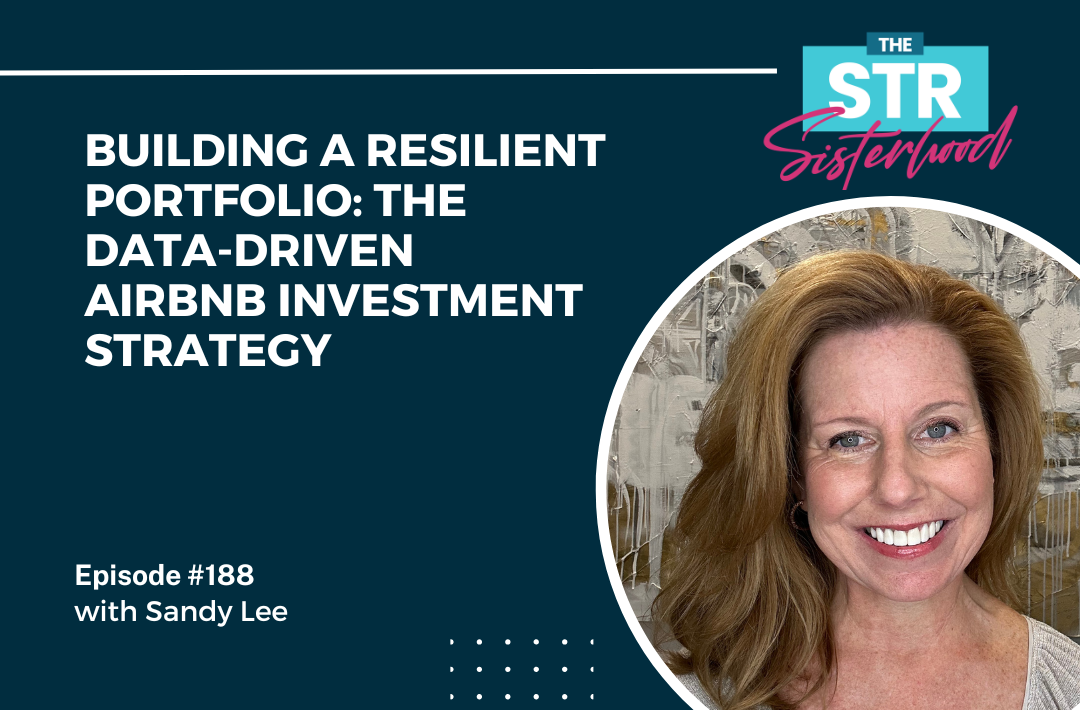
#188 Building a Resilient Portfolio: The Data-Driven Airbnb Investment Strategy
The short-term rental market can feel incredibly loud right now, filled with headlines warning investors to back away. Many owners and operators have experienced hesitation over the past eighteen months during a highly challenging economic cycle. However, the truth is that market uncertainty often creates the exact environment where a sophisticated Airbnb investment strategy can thrive.
In this episode, I am joined by returning guest Sandy Lee, an engineer-turned-investor who built a successful remote short-term rental portfolio across multiple locations in her fifties. Sandy shares how she looked past market noise by grounding her decisions in mathematical logic, moving from corporate transitions into real estate ownership. Whether you are a seasoned operator or looking to purchase your first property, shifting your perspective from fear to data will help you find undervalued opportunities.
Overcoming Fear with a Math-Driven Airbnb Investment Strategy
When market shifts occur, it is natural to feel anxious about deploying capital. Sandy experienced this firsthand when transitioning out of a shifting engineering and construction career in Houston. To overcome hesitation, she relied heavily on her technical background to analyze deals.
A successful Airbnb investment strategy requires you to step away from emotion and back down into a spreadsheet. For Sandy, it took a year and a half of careful underwriting before she felt brave enough to take her first step and purchase a property. If you find yourself stuck in analysis paralysis, remember that numbers provide a baseline safety net.
The underlying data must make financial sense on day one. Your calculations should prove that, based on historical market trends, the property will yield a stronger return than standard index funds or stocks. Real estate grants you a level of operational control that traditional paper assets simply cannot match.
Shifting from Corporate to an Automated Analytics System
Running a lean real estate business means you often have to play every single role, from accountant to guest relations officer. In our corporate lives, we saw how larger organizations leverage advanced metrics; both Sandy and I spent years building data frameworks and pushing dashboards in global consulting and IT firms. Today, artificial intelligence allows small business owners to replicate an entire analytics team automatically.
To optimize your Airbnb investment strategy, you can connect advanced AI models like Claude directly into hospitality software systems like Hospitable. Sandy utilizes this automation to manage her business efficiently:
- Automated Pacing Analyses: She runs performance reviews twice a week to compare year-over-year revenue pacing.
- Plain-Language Summaries: The software translates complex operational dashboards into concise paragraphs highlighting key trends.
- Catching Platform Blind Spots: Automated reports help identify anomalies, such as a property booking frequently on Vrbo or Booking.com while receiving zero Airbnb bookings for a consecutive month.
By utilizing tech platforms to handle deep data extraction, you collapse the time required to manage properties while gaining a sharp competitive edge. You can review performance baselines on BiggerPockets to see how modern investors use automated tools to scale without adding overhead.
Looking Beyond the Numbers to Find Market Magic
While spreadsheets establish your baseline financial safety net, relying solely on historical calculators means you have the exact same data as your direct competitors. To truly outperform the market curve, you must look beyond static data points to identify future macroeconomic catalysts. You need to ask yourself what unique development will transform a specific local economy over the next three to five years.
Sandy successfully applied this forward-looking methodology across multiple diverse vacation rental markets:
- Steamboat, Colorado: She purchased an expensive property after tracking a major corporate acquisition by Aspen, which brought massive infrastructure investments, extra gondolas, and stricter local regulations that limited future short-term rental supply. This combination successfully doubled her projected paper returns.
- North Carolina: She purchased a mountain property situated near a completely closed ski resort that was undergoing a quiet, multi-year rehabilitation project.
- Orange Beach, Alabama: She identified a property located just five miles from the Gulf Shores Airport right as it transitioned into a commercial terminal, triggering an organic influx of tourism.
- Texas: She acquired a new condo built within walking distance of an iconic local dance hall, capturing a highly localized concert-goer market where alternative transit options like Uber were unavailable.
Conversely, relying strictly on national “top investment lists” without local due diligence can lead to costly mistakes. For instance, Hamilton, Ohio once ranked highly on a short-term rental list due to a new sports complex generating youth athletics travel. However, out-of-market investors quickly discovered severe local challenges regarding crime and safety that a basic calculator could never reveal. Always research regional municipal indicators, such as massive highway construction projects, hotel development permits, or shifting national and state park boundaries, to find hidden growth pockets.
The Mechanics of a Successful Property Launch
Once you find the right market, execution determines your actual yield. A common mistake is rushing a property to market using amateur smartphone photos just to capture immediate calendar dates. In our educational curriculum at Stacey St. John, we emphasize that the first thirty days of a listing are absolutely critical to platform algorithms.
Platforms utilize asset quality data to determine visibility metrics. Waiting an extra week and a half for professional media styling creates a substantial compounding advantage over the lifetime of the asset.
Your launch pricing framework must also remain entirely strategic and separate from personal ego. When debuting a freshly renovated property, set initial rates highly competitively to secure three to five high-value bookings quickly. Once those initial guests leave flawless, verified reviews, you can steadily increase rates toward the market median. Sandy targets a stable 70% annual occupancy rate by maintaining balanced pricing directly in the middle of the local curve, prioritizing consistent business revenue over speculative high rates.
Strategic Alternatives for Hesitant Investors
If high asset pricing or seasonal volatility makes a direct property purchase feel too risky, remember that a real estate investment strategy does not require a single rigid path. You can divide the industry into two distinct components: the real estate asset and the day-to-day operations.
For capital-constrained or risk-averse individuals, strategic co-hosting partnerships or property management contracts offer an exceptional entry point. Co-hosting allows you to manage operations for other owners, earning immediate operational cash flow while learning market dynamics without personal financial liability. Alternatively, property owners with busy corporate schedules can simply acquire hard real estate assets and outsource 100% of the operational management to a trusted co-host, protecting their time while building long-term equity and securing a personal vacation destination. Shifting your business approach away from market fear and toward clear operational systems ensures your real estate portfolio works effectively for your long-term wealth.
Click here now to listen to the full podcast.
HIGHLIGHTS AND KEY POINTS:
[00:50] A short introduction about our guest Sandy Lee and her reflection on how a major career transition in her 50s, pushed her to explore short-term rentals
[02:54] Sandy shares about the use of data and AI to build confidence and simplify decision-making in short-term rentals
[05:46] Sandy and I discuss how AI has evolved beyond simply analyzing data to becoming a strategic business partner
[09:39] Sandy explains why she believes now remains an attractive time to invest in short-term rentals despite recent industry challenges
[11:39] Sandy and I discuss the many ways investors can build a diversified real estate portfolio, emphasizing that there is no single path to success
[13:09] Sandy’s approach to finding investment “magic” beyond the data to anticipate future market growth
[19:58] How to identify emerging opportunities by paying attention to large-scale developments, infrastructure projects, and long-term regional shifts that may signal future growth in a market
[24:15] Sandy’s approach to balancing conservative underwriting with strategic, forward-looking real estate investment decisions
[25:51] The importance of timing in real estate acquisitions is highly situational and ultimately comes down to the underlying numbers and the investor’s financial flexibility
[30:11] Sandy and I discuss two critical components of a successful short-term rental launch: professional photography and strategic pricing
[33:30] the importance of intentional pricing strategy at launch, particularly in the context of property management and co-hosting relationships
[35:26] Sandy’s perspective on overlooked short-term rental opportunities that help investors move past fear and re-enter the market strategically
[37:53] Sandy’s breakdown of the ownership and operations paths in short-term rentals, and how co-hosting creates flexible entry and exit options
[39:53] The lightning round
Golden Nuggets:
- “If I start to get anxious and if things start to seem scary, I’ll back down into a spreadsheet, and I’ll think really hard about it, and I’ll look at all of the numbers. It has got to make financial sense.”
- “If you don’t have money to invest in property right now, starting out co-hosting is a fabulous way to get your feet wet, earn that cash flow that you can eventually invest in the real estate asset.”
- “Do the big scary thing that you’re afraid of. I mean, that’s the best piece of advice. What’s the worst thing? Figure out what the worst thing that could happen is, and work yourself through it, and do it anyway.”
Connect With Our Guest:
Instagram : https://www.instagram.com/strjumpstart/
Website : https://www.strjumpstart.com/
Did you enjoy the episode? Don’t forget to Subscribe, Rate, Review, Like, and Share!