How to Make Your Airbnb Property a Destination: 4 Lessons From Joanna Gaines
The fastest way to make your Airbnb property a destination isn’t a bigger market or a trendier town. It’s designing one intentional, memorable moment on your property that guests plan their trip around — the way Joanna Gaines turned a rusty lot in Waco, Texas into one of the most visited attractions in the state.
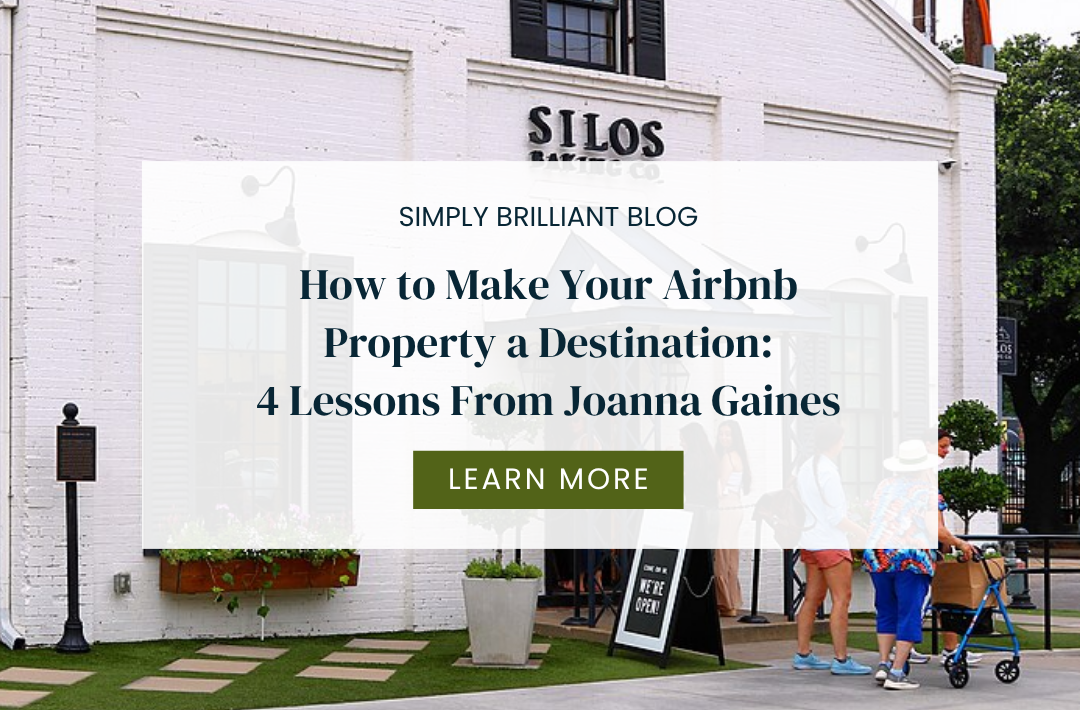
There’s a pair of grain silos in Waco, built in 1950, sitting on a lot most people only knew for all the wrong reasons. Today, that lot draws over 1.6 million visitors a year — more than the Alamo. People plan vacations around a shopping market in a small Texas town.
The woman behind it is Joanna Gaines. And here’s what makes her story useful to you: she and Chip don’t just build brands. They own vacation rentals. One home in tiny McGregor, Texas has been listed on Airbnb starting at $875 a night.
None of that came from a great market. It came from a playbook — and every piece of it works at your scale, in your town.
Key Takeaways
- A paused season isn’t a stopped dream — the business that came next often grows directly out of what looked like a detour.
- Guests don’t travel for towns. They travel for feelings, which means your property itself can be the destination.
- If a hundred percent of your bookings come from one platform, you’re the star of someone else’s show, not the owner of your own business.
- A comp analysis can’t price what a guest feels. That gap between comps and feeling is where a real brand gets built.
- Data over drama applies to expansion, design, and even the doubt you feel in a slow season.
Want to see how these ideas come together? Watch the full YouTube video to discover four lessons from Joanna Gaines that can help you turn your Airbnb into a destination guests remember, share, and plan a trip around: [Watch the full video here]
Why Most Hosts Think They Need a Better Market
Most hosts believe the biggest lever they have is location. My town is boring. There’s nothing here. I can’t compete with the beach.
Waco says otherwise. Grain silos. More visitors than the Alamo.
Guests don’t travel for towns. They travel for feelings. That means the market you think is holding you back usually isn’t the real problem — the design and story of your property are.
Lesson 1: A Pause Is Not a Stop
Joanna opened a tiny home goods shop in 2003, and it was doing well. Then she closed it — not because it failed, but because that season belonged to her babies. Years later, she reopened, and everything now known as Magnolia grew out of the business she had paused.
If you’ve stepped back from a dream — for your kids, your health, your family — that pause isn’t a missed window. It’s tuition.
Name your current season honestly: building, pausing, or restarting, and drop the guilt about which one it is. Write down two skills your “detour” season is building that your rental business will need later. Nothing is wasted.
And even after the Gaineses went all in, it wasn’t a straight line. During the housing crisis, there was a stretch of four or five years where every single Friday, Joanna and Chip asked each other, “Are we gonna make it?” If you’re in your own Friday-question season, you’re not behind. You’re in the part of the story people interview you about later.
Lesson 2: Make Your Property the Destination
When Chip and Joanna bought their property in 2015, Waco wasn’t a destination. They didn’t find a great market. They made one, by designing an experience so intentional that people now drive hundreds of miles for it.
Guests don’t travel for towns. They travel for feelings. That means your property itself can be the reason someone comes — the design-forward cabin people drive three hours for, the space that shows up on someone’s feed and makes a stranger ask, “where IS that?”
How Do You Make Your Airbnb Property a Destination Instead of Just a Place to Stay?
You make your Airbnb property a destination by designing one intentional, photo-worthy moment guests remember and share, rather than trying to be generically nice throughout. Most listings spread their effort evenly across every room, which makes the property pleasant but forgettable. A destination property does the opposite: it identifies one feature, view, or design moment — a reading nook with a specific view, a striking outdoor space, a themed detail no other listing in the area has — and invests real intention into making that one moment unforgettable. Guests photograph it without being asked, share it online, and other travelers start asking where it is. That single moment, built with intention, does more to differentiate a listing than a dozen small, evenly distributed upgrades ever could.
Walk your property and find your silo: the one feature, view, or moment you could design so intentionally that guests photograph it without being asked. Every guest photo is free marketing, and every “where is that?” comment is a future booking. Design one photo-worthy moment this quarter, and audit your listing photos — does the first image show your silo, or just another bedroom?
Lesson 3: Don’t Build Your House on Rented Land
In 2018, Chip and Joanna walked away from Fixer Upper at its peak. They came back with their own network instead. If a hundred percent of your bookings come from Airbnb, you’re the star of someone else’s show — the platform owns the algorithm, the guest relationship, and the rules, and can change any of them tomorrow without asking you.
The platforms are wonderful for discovery. Use them. But build your own assets alongside them.
Own your brand: give your property a name guests remember and search for. Own your guest list: start capturing emails, because a past guest you can reach is worth more than a stranger the algorithm might send. Own a direct booking path, so repeat guests and referrals can come straight to you. For more information on building your brand, check out my podcast interview with Tori Bolt.
Lesson 4: Charge for the Feeling, Not the Square Footage
No comp analysis on earth says a house in McGregor, Texas rents for $875 a night. The market doesn’t support that price. The brand does. Guests there aren’t renting bedrooms — they’re buying a feeling.
Write your property’s design identity in one sentence: the single feeling carried through every room, photo, and touchpoint. Audit every room against that sentence — what belongs, and what’s just furniture you had plus clearance decor?
Once your identity is consistent, test a premium above your comps, and let your reviews and occupancy data tell you if the feeling is earning it.
Frequently Asked Questions
What if my rental market genuinely doesn’t have much tourism draw?
Waco didn’t either, before the silos. Guests travel for feelings, not towns, so a property with a strong enough design identity can become its own destination regardless of the market around it. The market often matters less than hosts assume.
How do I know if I’m too dependent on one booking platform?
If all your bookings come from a single source and you have no way to reach past guests directly — no email list, no property name they’d search for, no direct booking path — you don’t yet own an asset. You’re renting your audience from the platform.
Can I really charge more than my comps suggest?
Comps price square footage, not feeling. Once your property has a consistent, intentional design identity, you can test a premium above comps and let occupancy and reviews confirm whether the feeling is actually earning it. Start with a modest increase and watch the data.
I’m in a paused season right now. Should I feel behind?
No. A pause isn’t a stop. What you’re building in this season — patience, clarity, skills you don’t realize you’re developing — is often exactly what the business needs later. Nothing is wasted.
What’s the difference between a themed property and a destination property?
A themed property decorates around a concept. A destination property designs one specific, intentional moment intended to be photographed and shared. The distinction matters because a destination property earns free marketing through guest photos, while a themed property often just looks nice without generating the same word-of-mouth effect.
How do I start capturing my own guest email list?
Ask for an email at check-in or in your welcome guide in exchange for something useful — local recommendations, a discount on a direct future stay, or an early look at availability. Consistency matters more than the specific incentive; the goal is simply to stop relying on the platform as your only connection to past guests.
Is it worth naming my short-term rental property?
Yes. A memorable property name gives guests something to search for, remember, and tell friends about — the first step toward owning your brand instead of only existing as a listing number inside someone else’s platform.
Final Thoughts
Rusty silos in Waco. A paused dream. A show they walked away from at its peak. Today: millions of visitors, a network of their own, and rentals that break every comp in Texas. That’s not luck. That’s a playbook.
Is your property designed around one intentional feeling, or is it pleasant everywhere and memorable nowhere? Are you building assets you own, or renting your entire audience from a platform that can change the rules tomorrow? And if you’re in a paused season right now, what is it quietly building that you haven’t given yourself credit for yet?
You don’t have to answer those questions by yourself. That’s exactly why I built the STR Sisterhood — a place to bring your real property, your real design decisions, and your real next step, and get honest feedback from women a few steps ahead of you.