September 15, 2026
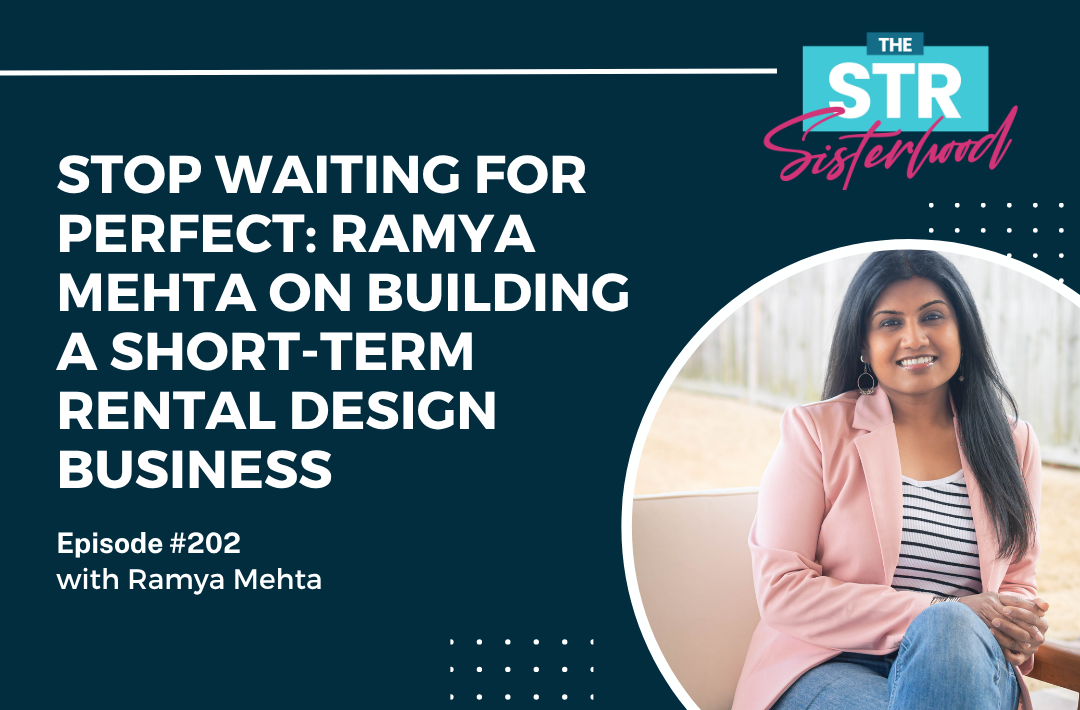
#202 Stop Waiting for Perfect: Ramya Mehta on Building a Short-Term Rental Design Business
Ramya Mehta had her logo, her color palette, and her Instagram grid sitting on a to-do list before she’d let herself call Yellow Tulip Designs a real business. Her mentor listened to the whole plan and said the thing she needed to hear: “You don’t have to have all that. Just go ahead and start it.” That’s where this conversation about building a short-term rental design business actually starts — with a product manager in Birmingham, Alabama who was already good enough to charge, and still waiting for permission.
She’s a product manager by day. A designer by night. And a mom whose kids walk into her home office mid-workday to ask her things.
Here’s why her story matters even if you never design a property. She’s using skills she already had, and she stopped waiting to feel ready.
Two Family Projects, and a Short-Term Rental Design Business Was Born
Ramya didn’t set out to start a short-term rental design business. Her sister and brother-in-law asked for help with design decisions on a property. She loved the process. Then it happened again.
“Within their second property, I was hooked,” she said.
Most people wait for a business idea to arrive fully formed. Usually it shows up as the thing you keep saying yes to that doesn’t drain you.
So here’s the question: what are you already doing for free, over and over, that people keep coming back to you for?
The Product Manager’s Lens on Guest Experience
Ramya described product management as balancing priorities, aligning stakeholder expectations, constant communication, and the user journey.
Then she mapped it straight onto design. Clients come with a budget and they want a return on it. Her job is to decide what delivers the highest value and move that up in the execution order.
Putting Yourself in the Shoes of the Guest
Her workday starts by writing user stories: as a user, I want this, so that I can. She runs short-term rental design the same way.
“I’m putting myself in the shoes of a guest to see how I can elevate their experience, how I can provide, make them feel that this was the right decision that they took to book that property.”
Read that again. She isn’t designing to a style. She’s designing to confirm a decision the guest already made.
That’s the gap between a pretty property and a property that earns five-star reviews.
Perfectionism Isn’t a Branding Problem
Ramya is honest about this one. She wanted the logo, the palette, and the Instagram finished before launching. She’s also not someone who naturally puts herself on camera.
She isn’t unusual. Research from the American Psychological Association found perfectionism has risen sharply across recent generations.
But look at what perfectionism actually does inside a business. It’s not a standards issue. It’s a decision you keep postponing while calling it preparation.
Her fix was practical. She built systems and automated what she could, accepted that the rest wasn’t finished, and started anyway. As she put it, it’s going to get better — she doesn’t have to have it all figured out today.
So what decision are you currently filing under “not ready yet”?
Ruthless Prioritization Is a Filter, Not a Time Hack
Ramya has a full-time career, young kids, friendships she protects, and a growing business. Asked how she manages it, she didn’t offer a calendar trick.
“Ruthless prioritization,” she said. “If something doesn’t provide significant value in my life, it’s not worth my time.”
She doesn’t time block. She’s a list person who clears the small, achievable tasks first, then moves into the long ones.
Notice what that really is. It’s a filter she applies before anything reaches the list.
Most owners try to fix an overloaded week by scheduling harder. The relief comes from deciding what doesn’t earn a slot at all.
It’s the same when her kids interrupt the workday. She listens, weighs the urgency, and often tells them: let’s come back to this tonight. That’s a decision rule, not a mood.
Communication Is the Skill That Transfers
The corporate skill Ramya leans on most? Keeping people informed. Progress, roadblocks, all of it.
She said that feedback loop is genuinely appreciated, no matter how small the update.
We talked about how this plays out with guests. When there’s construction at a resort we manage, we tell guests before they arrive. They may not love it. They’ll handle it.
The problem is almost never the problem itself. It’s the surprise.
If your guest finds out at check-in, you don’t have an operations failure. You have a communication gap that’s about to become a review.
How AI Changed Ramya’s Research and Her Renderings
Ramya uses AI heavily in her short-term rental design process, and she uses it specifically. Market research on an area before she designs. Competitive analysis on comparable properties. Scanning thousands of reviews to spot patterns in what guests praise and what they complain about.
That isn’t a shortcut. That’s how she walks into a client conversation with a data-backed recommendation instead of an opinion.
What Short-Term Rental Design Clients Need to See
She also creates AI renderings from her design boards, for an operational reason. A two-dimensional board is hard to sell because clients can’t picture the finished room.
She’s clear-eyed about the limits. Renderings hallucinate, so she puts disclaimers in place.
If an owner has ever stalled on approving your plan, borrow this. The hesitation usually isn’t the budget. They just can’t see it yet.
Mentors, Community, and Two Words That Open Doors
Ramya credits her mentors for direction and strategy. It takes a village, she said — then named the part most people skip. Plenty of people are willing to help. We just have to ask.
That’s also the best advice she’s ever been given, from a family friend when she was young: “Just ask. The worst thing that’s going to happen is they’ll say no, but if you don’t ask, you’re not going to get it.”
She teaches it to her kids now. She won’t ask on their behalf, and she’s watched their confidence grow because of it.
And here’s the flip side. You don’t need to know everything to be useful to someone else. Knowing 5 to 10 percent more than the person asking is enough to make a real difference.
You’ll Figure It Out
The line I keep returning to is Ramya’s own: you’ll figure it out. Every challenge she’s faced, she’s worked through. That’s evidence, not optimism.
Which is what makes waiting so expensive. You’re not waiting on information. You’re waiting on certainty, and it isn’t coming.
So take the next thoughtful step — in your short-term rental design work, your co-hosting offer, or whatever you’ve been circling for months. Then adjust as you go.
And if you’re building a service business around other people’s properties, The Co-Host Code walks you through the pricing, contracts, and systems to do it properly.
If you’ve been figuring it out alone, come do it with women who get it. Join us inside the STR Sisterhood.
Click here now to listen to the full podcast.
HIGHLIGHTS AND KEY POINTS:
[00:49] A short introduction about our guest Ramya Mehta and what sparked her interest in short-term rental design
[03:50] Ramya explains how her career as a product manager directly influences her approach to designing memorable short-term rental experiences
[06:35] How designing Ramya’s family’s second short-term rental gave her the confidence to turn her passion into a business
[07:59] Ramya opens up about overcoming perfectionism and learning to put herself out there before everything felt ready
[10:37] Ramya shares how personal loss, purpose, and creating value help her push through fear and uncertainty
[14:54] How ruthless prioritization helps Ramya balance motherhood, a corporate career, and growing her design business
[19:07] Ramya highlights how strong communication from her corporate career has become a foundation for her design business
[21:38] Ramya explains how AI has transformed her design process by helping her create data-backed strategies and visualize client concepts
[25:25] How mentorship and community have helped Ramya confidently navigate a new industry and continue growing
[28:14] Ramya reflects on how stepping beyond the corporate world allowed her creativity to become a new career path
[28:49] The lightning round
Golden Nuggets:
- “I’m putting myself in the shoes of a guest to see how I can elevate their experience, how I can provide, make them feel that this was the right decision that they took to book that property.”
- “You don’t have to have all that. Just go ahead and start it.”
- “You just have to live your life and do what you want to do and do good.”
- “If something doesn’t provide significant value in my life, it’s not worth my time.”
- “Just ask. The worst thing that’s going to happen is they’ll say no, but if you don’t ask, you’re not going to get it.”
Connect With Our Guest:
Instagram : https://www.instagram.com/yellowtulipdesigns/ Website : https://www.yellowtulipdesigns.com/
Full Episode Transcript:
So today we are joined by Ramya Mehta and we are hearing all about her short but exciting journey in the short-term rental space. Ramya, thank you so much for being here. Stacey, thank you so much. Such an honor. I’m really excited about this. Thank you. You are more than welcome. And I am a huge believer that everyone has a story to tell. And I am so excited to hear about your story.
Let’s, first of all, have you share with our audience a little bit about who you are and where you live in the world. Yeah, so I am a short-term rental interior designer. I’m new to the space. I have great mentors. And I also have a corporate career going on on the side. So I do. I’m a product manager by day, designer by night, a very busy mom. I live in Birmingham, Alabama. This has been my home for, I don’t know, 24, 25 years now. Yeah. So very busy and I love it.
I wouldn’t have it any other way. I love that. I love that. And I loved how you said, you’re a product manager by day and a designer by night. And maybe on the weekends, it’s the opposite, perhaps. But so often, women are juggling multiple things. So- I’m really curious, you know, let’s start at the beginning. Obviously, you have a successful career in the corporate world. What first sparked your interest in short-term rental design? So I love creativity in any form or shape of it. I just enjoy it. It puts me in a very different Zen mode.
I just enjoy it in any shape or form. But specifically in short-term rentals, I was pulled to it because of my sister and brother-in-law. They have they wanted me to help out with some of their design decisions. And I just thoroughly enjoyed that process. And then it happened again. And I was like, wait, this is something I can do over and over again. And I could tap into that creativity and provide valuable help to people who actually need that help or don’t have that time to take it on themselves. So that’s when I really seriously started thinking about it.
And, you know, I’ve done the corporate job. I’m still doing it. But it doesn’t tap into that creativity as much as I would like to. So that’s when this was born. And, yeah, I haven’t looked back since. I’ve really this world has so many wonderful people I’ve met. network to so many people with so many I have so many great mentors and yeah I’ve been very fortunate that in my short span so far I’ve already worked on a couple of projects so it’s been amazing. That’s wonderful. Now tell us what you do by day.
I know a product manager, but what is a day, a typical day look like for you as a product manager? And then on the flip side, I would love for you to help contrast how you’re using that creativity that you’re not using in your day-to-day job. In terms of design? In terms of your design, yep. You know, product management is all about balancing priorities, right? You want to do everything. You cannot do everything. You have to figure out what you want to do the most that will give you the most value.
It’s about alignment of expectations between all your stakeholders. It’s constant communication. Keep them updated with progress or pitfalls that might happen. And user journey. It’s all about that. That’s what product management is. And so when I reflect back on it, that’s what interior design is all about. You have clients who have these massive budgets that they want to see ROI on. How do you provide meaningful value to them with that budget in mind? provide, make sure we prioritize and give those high value returns to them and push that up in terms of execution and design.
Keep them communicated, keep those feedback loops open all the time and use a journey. As a product manager, that’s what I do day in and day out. My day starts off writing stories as a, user. I want this so that I can. That’s what product management is. And that’s really what I do for the design world. I’m putting myself in the shoes of a guest to see how I can elevate their experience, how I can provide, make them feel that this was the right decision that they took to It kind of goes really hand in hand and I’m really able to translate my day-to-day work in this design world.
So it’s pretty, pretty cool actually. Wow. I love that you’ve walked us through that because, you know, I, I would have assumptions that a product manager, uh, You know, you mentioned writing stories about what how you want your customers interface with the product. Now that you say that, it makes complete sense. However, I wouldn’t have expected you to say that. So I can absolutely see where you’re able to translate those same core characteristics and skills that you’re using in your corporate job and apply it to short term rental design. I’m curious.
When you first got started, obviously, your family had asked you to help out on a few projects. At what point in time were you like, hey, I can help other people outside of my family. This could be a real viable business. Within their second property, I was hooked. And I really wanted to continue doing this. And corporate job is great. And with the STR Sisterhood, you know that we’re all talking about financial freedom. We are always talking about what we want to do, the fire movement and all of that. You know, I’m the person who cannot sit still and not do anything.
I’m sure you relate, Stacey, with that, right? But what do I do is this was the answer for me. I am able to do this all day long, every day, and not feel the burnout. It’s just been something that really gives me a lot of passion. I mean, I’m very passionate about it, and I’m able to provide support value there help somebody and yeah I can see this do see myself doing this for a very long time what I want to continue doing I’m really passionate about it I I’m curious also you know one of the things that I love is that we’re having this conversation early in your career a lot as far as in the short-term rental design space a lot of women I know struggle with perfectionism I will say I’m a recovering perfectionist.
Okay. So I’m including myself in this, but oftentimes what I see is folks are hesitant to share their stories and hesitant to put themselves out there because they want to wait until they have everything figured out until everything is perfect. I’m curious, how does that resonate with you? And what has given you the courage to put yourself out there, even though you’re early on in your journey? yeah you know i’m putting myself in that bucket very much there in that bucket uh just to even launch my business i had to have it all figured out i wanted my logo in place i wanted my color palette in place i wanted my instagram looking good and i have a mentor who was saying you don’t have to have all that.
Just go ahead and start it. And I wouldn’t do it. I said, no, I need it all in place. It is a struggle. And I am not the kind of person to put myself in Instagram. If you had told me that six months ago, I would have just brushed it off. So something about this career has really, really, really ignited that passion in me to where I have been able to put all that behind me and say, I have to get this going. And the only way I can do that is if I put myself out there.
I have to get my name out there. I have to get my brand out there. I have to be able to resonate with people. And if I’m going to sit behind the scenes, that’s not going to work for me. So as scary as it is, because I haven’t got it to the perfection stage that I would like it to be, I do have systems in place, right? It’s because of that corporate world and just my personality in nature. I don’t like to do repetitive tasks without automating them. I’m looking for systems and automating stuff as much as possible.
So it’s going to get better. It doesn’t have to, I don’t have to have it all figured out today. I’m always learning from my mistakes, but yeah, I mean, I think we’re all humans at the end of the day and I keep reminding myself that. Amen. Yeah. You know, you mentioned it being scary and doing it anyway. And I think it’s just a great reminder because so often women especially will retreat when that fear becomes loud enough, when it feels uncomfortable enough, it’s really easy to go back to the comfort zone.
What have you personally experienced? found to be helpful in pushing through that fear, in doing the hard stuff anyway? What has helped you the most? Life is too short, Stacey. And we’ve had a very personal loss in my family, which you just have to live your life and do what you want to do and do good. that I underline that statement, make sure you’re providing meaningful value to people around you. And I think that trumps everything. And at the end of the day, I’ve learned through my life journey that you can figure it out.
As humans, as women, we have the power to Figure our way out. And that kind of gave me the strength to push on and carry on. And it’s not easy being in a full time job, being a mother, being having a side business. And but if you want to do something, you have to put that time in and you can figure it out. Mm hmm. I totally agree that life is way too short. My mom died at the age of 59. My mother-in-law died at the age of 59. I saw both my dad and my father-in-law navigating their later years in life in a very different way than they ever expected.
Um, you know, it’s a little strange. I’m 51 at the time of this recording. So I’m, you know, eight years away. I think about that timeline, you know, in eight years, my, you know, compared to my age, that’s when my mom passed away. First of all, I’m going to cross my fingers and toes that I have a much longer life. But at the same time, we do have to live every day as if it were our last one. Right. We just never know what’s going to happen. So I also love that you put in to practice making sure you’re bringing value for other people every day.
It’s very easy to get caught up in what do I have to do, my own task list. Every day before I start my morning, I’m writing a series of things down and But one of the things I’m writing down is what am I doing to help other people today? I love that you have that as a practice as well, whether you’re writing it down or just acting on it. I think that’s so important. Yeah, I think, you know, like, you know, life is short. Make sure that people remember that. you for good work.
So it could be anything small, but you know. Yes. Yes. So I want to talk with you because you are balancing a very busy career, being a mom and this newly developing business that you’re passionate about. Tell me how you prioritize your time because I am confident that you have multiple things pulling at you within a I mean, ruthless prioritization. That’s all I would say, just time management and prioritization of what it is that makes sense for my family. There’s just so much going on that if something doesn’t provide significant value in my life, it’s not worth my time.
and you know my kids come first they need me and they’re still youngish my work obviously I want to make sure I’m not putting that on the back burner and then my design plans I’m not you know that’s something I’m passionate about and I see myself doing in the next phase of my career and those are my priorities right now my family my work, my design and, you know, it’s ruthless prioritization. I have a very strong set of friends who are there with me all the time and I want to make time for them and make sure that I’m there when they need me.
And, you know, also try and spend quality time with them. It’s just not about work, work, work all the time. You want to have a healthy balance. So those are my priorities and I That’s how I manage my time. And just every day is different. Every month is different. And you just look at what you have to do that day and work through your highest immediate burning fires. Yeah. Yeah. What, tell me what would happen if, you know, let’s say you are working on a design for a design client and your kids are like, mom, we need you to do X, Y, and Z.
How do you make the choice about what you’re focusing your energy on when your kids may have pop-up ideas or pop-up requests, shall I say? It always happens. Let’s just be honest. It’s always there. You know, I tell my husband that he also works from home rarely, not as much as I do, but I work from home and they, my kids just waltz into my room and there’s a couch in my office and they will just hang out there and they ask me questions all the time and I’m like do you not see I am working here it’s it’s a true thing they want to be and you know that’s the perks of working from home and you have to figure out so you know for the kid in the mind of a child something could be a high priority and I just kind of figured out I listened to what they need and then based on how urgent it is, I might tell them, hey, can we just come back to this evening?
Or, you know, when I take a break, we will look at it. And of course, if it’s something urgent, I definitely attend to it. But it’s always trying to figure out what is the priority and the urgency of the ask at that point in time. And are you a type of person, do you do time blocking? How do you manage your calendar? I don’t time block. I know what I want to do. I’m a to-do list person. That’s what I am. And I make sure that I am knocking out my smaller achievable tasks first.
It gives me a great sense of accomplishment, as you can imagine, just checking those things off. And then I get around to the ones that will take a little longer time to complete. But yeah, I’m a checklist person and I have my stuff that I need. I know that, again, back to product management, always prioritizing it in terms of how early I can finish something, what’s the value that it means, you know, just go by list and prioritize based on urgency. Love that. What’s one thing you learned in the corporate world that you’ve applied to your design business?
I think communication is something that can so easily be overlooked. That part is something that has really kept me on my radar all the time. And just not underestimating its value, no matter how small that communication is, I think that feedback loop is really appreciated. And that part is something that just… directly I can translate it from my corporate world into this and just keeping the clients informed of the progress or any roadblocks that I’ve hit or it’s just very very important to do keep keep that person updated of what’s happening.
I often find that when people even when there are hiccups you know, or unexpected things that happen. When we keep people in the loop and we’re in communication with them, listen, they may not be the happiest about it, but they understand and they’re often, you know, gracious about problems. When we don’t communicate with that, when we don’t communicate with our clients about challenges that have come up and then they’re hit with it, you know, out of the blue, that can become Same way in the short term rental space with guests, you know, let’s say there’s construction at, you know, a resort that you manage.
And I have had this happen firsthand. We always communicate that with our guests in advance so they can be prepared. The last thing we want to do is have our guests, you know, stroll up to a resort and have it be torn apart. Then they’re upset, you know, then they’re upset. So yeah. Yeah, I mean, at the end of the day, right, it’s human emotions, no matter what, right? Yes, we’re talking about ROI, we’re talking about tax savings, all of that in short-term rental. But at the end of the day, it is emotions, no matter what.
Your client budget is there. If that’s not met, they are upset. If the client, if the guest comes in and they find it not looking like the images, they’re upset. It is emotions. We cannot take the human out of anywhere in this world of AI, right? You have to keep that in front and center and always treat that person with that, how you would like to be treated. Yeah, yeah. So you mentioned AI. How are you using AI, if at all, when producing designs or work for your clients? Yeah, so I am all AI.
I use AI, all sorts of it. I use Claude, ChatGPT, Gemini. I use it for research heavily. And I just, you know, I’ve set up systems to do that as well. where I am thoroughly doing a market research. So I spend a good bit of time before design to do my market research. So I’m really dwelling into that area, what it has to offer, why are the guests coming to that area? I use it for competition analysis to see what the like properties are doing, what are they offering? How are they performing better?
I scan through thousands and thousands of reviews to see if there are patterns in positive reviews versus negative. It’s just a blessing to have those AI skills and tools to do that work to you. It’s not humanly possible, not with my time anyway, but I have that thorough research in my hand so that I can go back to the client with a proper data-backed recommendation. That helps getting alignment as well to see where the vision and the strategy of the property can be. What is it that we really need to do with this property?
to make it stand out and make sure we’re not falling behind in anything. At the same time, how can we provide a unique amenity or something that will set us apart? So I use AI for that as well, along with me, myself, looking at the rates of the stays and what we’re charging and stuff like that. And also, I use AI. Once I have my design ready and all the vision and everything that’s curated, I’ve sourced everything, I do try and get an AI rendering of it. Because these days, it’s just so easy, so amazing to use.
Anyone can do it, right? Just feed in a vision. a design board and get a good AI rendering. And I know that helps a lot with the clients because a design board sometimes is all two-D and the clients are not able to see the ultimate vision. It’s hard to sell, honestly, because if they cannot get on board, it’s because they can’t visualize it. So that AI rendering, granted it’s AI rendering, sometimes it hallucinates, it can throw things that are not meant to be. Right. But I’d make sure those disclaimers are in place.
But it really helps driving that vision, driving that strategy across. And the clients appreciate it as well. So I use it a lot. What is your favorite tool to create that AI rendering? I use ChatGPT a lot. I know people like Gemini’s… forgetting the name. Banana. I’m forgetting the name. Anyway, but somehow Gemini has not… It has helped some, but ChatGPT has always… I go heavily to ChatGPT. Yep. Yep. I use Chat a lot. I love Claude as well. I will say I haven’t used Gemini to the extent that I know it’s got capabilities.
So that’s certainly something that… Um, no, I’m not a designer by any stretch of the imagination, but, um, in my business, you know, chat and Claude are, are my two go-tos shall we say. I’m going to go back to the question about, you know, being newer in this business. And I want to ask you, you know, from your perspective, walking into a whole new industry can, again, feel a little overwhelming. It can feel a little scary sometimes. you mentioned you have community around you, you have mentors. Why do you feel like it has been important for you to have mentors that you can plug into?
Oh my gosh, it’s invaluable. I mean, just, uh, They give you direction. They give you strategy. I can reach out to them with any questions I have with my design projects. The support that you need is provided by them. And it’s, you know, we cannot… It takes a village always, right, Stacey? You cannot be in this bubble by yourself and say, I’m going to… I know it all. I’ll do it all. No, it doesn’t work that way. And it’s not even just in this… design world and it applies anywhere. You need mentors around you.
You have to, it just elevates you as a person and then you want to turn around and pay that forward. You be a mentor to somebody. So it’s something that this world needs. There’s just so much going on that you want to surround yourself with people who are cheering you all the time and That’s a good mentor. So, yeah, I think there’s it’s something if someone has not done that, I highly recommend that they reach out to people. There are so many people who are willing to help. We just need to ask.
Yeah. And I also think, you know, it’s important to highlight what you mentioned earlier. you are looking for opportunities to pay it forward to someone else a lot of people have this frame of mind where oh i don’t know enough to help someone else yet and all you have to know is 5 to 10 percent more than someone else to really be able to make an impact so look for opportunities if you’re listening or watching look for opportunities for when someone ask the question or post the post or, you know, share as a challenge or a problem, you know more than you think you do.
So look for opportunities to help someone else and pay it forward. Because I don’t know about you, Ramya, but I go to bed at night sleeping better because I’ve had the opportunity to help someone that day. Makes the world go around a little easier, I think. Yeah, absolutely. I am curious if you were to look at yourself five years ago, would you envision yourself having a short term rental design business? No, I was just too tied up into the corporate world to think there’s a possibility outside it. Um, but I’ve always done creative projects.
That’s always been a part of me. So, um, it would not have surprised me, but, uh, No, I did not think about it five years ago. And I’m glad I did now. Better late than never. Amen to that. Amen. Okay. I want to move to the lightning round. All right. I’m going to ask you a series of questions. You just answer with the very first thing that comes to mind. First question is, where is your favorite place to vacation? Oh, my gosh. So… That is a hard one. We’ve been fortunate to travel quite a bit.
And, you know, some really fascinating places we’ve been. But I think at the end of the day, the mountains really, really speak to me. Something about the air over there and the scenery, I just enjoy. So, yeah, I’m going to go with mountains. Okay. Any specific mountains that are your favorite? Yellowstone. Yellowstone. Oh my gosh, just a different experience altogether. We were in Whistler recently near Vancouver and it was amazing. Yeah, I’ll go with Yellowstone. It was just gorgeous. That’s one place I’ve never been, so I’m going to have to make it that way out there.
It was amazing, Stacey. Oh, it’s on my bucket list. Next question. What’s one place you’ve never been that you want to visit? Yeah, there’s two on my top, top list. One is an African safari and the other is Switzerland. So both two places. We’re going to go. I’m sure we’ll go. Yes, yes, yes. I love it. I love it. I… I would envision Switzerland is going to have some yummy chocolate and African Safari. I am actually planning a first. You’re hearing it here first. I’m planning an African Safari for us in the STR Sisterhood.
Oh my God. From rental world in 2028. Oh, wow. Yes. That sounds amazing. All right. What is one thing you know now that you wished you knew when you were starting out in the world of short term rental design? I wouldn’t say specific to short term rental design, but I think it applies, generally speaking, is You’ll figure it out, right? I think it’s always we stop to make a decision or proceed with something just because we’re always wondering what if this goes wrong or I don’t know that and how will I manage that?
All these kinds of questions that are limiting beliefs at the end of the day. And, you know, I’ve just learned over the years that every challenge, every situation, I have figured it out. So I think that’s what I keep reminding myself that no matter what, I’ll figure it out. It’ll be okay. It’s not as bad as it seems. Everything is figureoutable. Absolutely. Absolutely. How about this one? What’s the best piece of advice you’ve ever been given? Yeah, that one is easy. It’s just ask. One of my very close family friends, I was really young and he had mentioned to me and he had said, just ask.
The worst thing that’s going to happen is they’ll say no. But if you don’t ask, you’re not going to get it. So yeah, I teach that to my kids even today and I follow it even today. I think it’s an amazing piece of advice. Absolutely. And, you know, you think about folks who are in the design space in the short term rental world doing co-hosting. You know, sometimes it’s easy to have a discussion with someone and think that you’re dropping hints about how you can support them. But if you just go ahead and ask like, hey, I would love to support this project.
What additional information would you like from me in order for you to make an informed decision? You know, it doesn’t have to be like in the hard world of sales, you know, they’ll say always be closing and ask for the sale. I think it’s really important to ask for if you want that piece of business, ask for it, but you can do it in a professional way too. It doesn’t have to be like, sleazy and slimy. Yeah, absolutely. I mean, we, that’s how this world works, right? We all are looking for opportunities and we, yeah, you, you have to ask.
It’s as simple as that. It does not have to be complicated. Right. Right. And I am curious about, how your kids have been receptive to that? Are they asking questions? Are they asking for things that they want? Maybe, I guess my kids would ask for everything in the store that they would want, but how is that playing out for them in real life? I mean, it’s really helped with their confidence, right? I’ve seen my kids being very shy, especially if they have to approach an adult. And I’ve been constantly reminding them that.
And I will not step in for them. I’m like, no, you go ask them. And so I have seen them really mature. They go ask. They don’t have those inhibitions. They will ask. And sometimes it will come and bite me and they’ll say… I’m going to ask you, you told me to ask. So, you know, it has its repercussions too. For the most part, all positive. That’s so great. That’s hilarious. All right. Last question. What’s one thing and or person that you’re grateful for today? I cannot choose one person, Stacey.
My husband, obviously my kids, they are my cheerleaders, my sisters, my mom, my mentors my friends everybody has been so good they have been really so positive and encouraging me and it really did it takes a village as they say and i’m just so grateful to the support that i’ve received so yeah i’m going to say all of them very very grateful for everything yeah So special to have so many wonderful people in your life. I also think for the folks who may be watching or listening that maybe don’t have a support system like that.
That’s exactly why we have communities like the STR Sisterhood so that we can band together and support one another. And I’m grateful for… for all the wonderful people I’ve had the opportunity to be exposed to, to support myself. And I don’t know about you, but I learn every day from the people I’m surrounded by. I’m sure you do as well. Yes, absolutely. Ramya, I’m curious if someone would love to get a hold of you or learn more about how you might be able to support their short-term rental design project, where is the best place for them to find you online?
Yeah, so my company business name is Yellow Tulip Designs. So I’m on social media, Instagram as Yellow Tulip Designs and my website is yellowtulipdesigns. com. So yeah, I’m very active and I would love to hear from you. I love it. Thank you so much for being here. Thank you, Stacey. Thank you so much. I’m very grateful. You bet.
Did you enjoy the episode? Don’t forget to Subscribe, Rate, Review, Like, and Share!