October 13, 2026
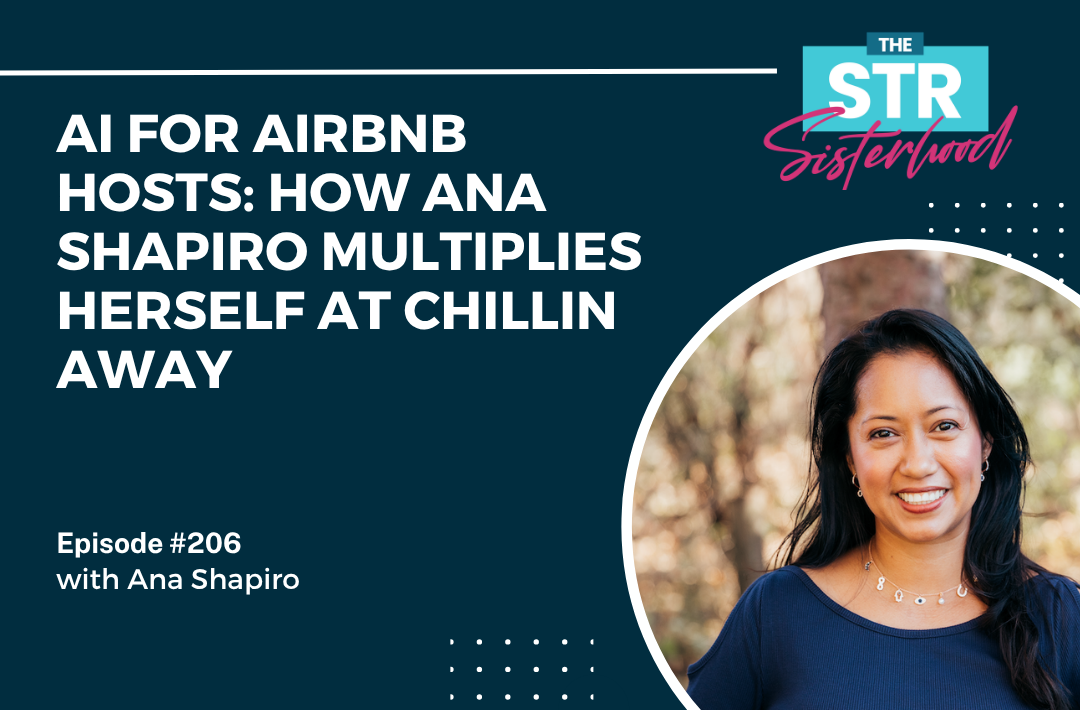
#206 AI for Airbnb Hosts: How Ana Shapiro Multiplies Herself at Chillin Away
“It’s passive income until the cleaner is running late, until the guest is checking in early, and until the hot tub has decided to act up.”
That’s how Ana Shapiro, founder of Chillin Away, describes running three family-friendly short-term rentals in Bass Lake, Indiana; South Haven, Michigan; and the Smoky Mountains. It’s also why her approach to AI for Airbnb hosts starts with a problem most of us never name.
After nearly two decades in real estate, Ana realized the biggest limitation in her business wasn’t the properties, the capital, or even demand.
It was that everything depended on her brain.
So what if AI could help you grow without removing the very thing that makes hospitality feel human? That’s the question Ana answers on this episode of the STR Sisterhood podcast.
And if you’re thinking, “That sounds great for someone with three properties, but I’m still figuring out my first,” stay with me. Ana’s advice on where to start doesn’t require a portfolio or a single line of code. It starts with your inbox.
[Podcast player embed]
Key Takeaways
- Ana uses AI to multiply herself, not replace herself. She’s building specialized agents for revenue, operations, guest experience, and marketing, and she approves everything.
- Her biggest AI mistake was in bookkeeping. Without checkpoints, a month of her books became “a complete disaster.” Now AI does a dry run first, and she approves.
- AI watches her same-day turnovers through lock activity and checks in with a late cleaner before it becomes a bad review.
- Hospitality, judgment, and taste stay human. AI’s job is to remove the chaos, not the heart.
- Her advice for getting started: have AI read your email every hour and draft replies you review.
It’s Passive Income Until the Hot Tub Acts Up
Let’s be honest. Operating a short-term rental is anything but passive.
If you want passive, stay on the real estate side and hire a property manager or co-host. If you’re operating, you’re in it every day.
Ana felt that shift firsthand when she moved from long-term rentals. With a good tenant, you might hear from them once a year at lease signing. With a short-term rental, you follow the guest from booking to checkout, and you watch pricing “every day like an airfare.”
That isn’t just more work. It’s a different business model. And a different model needs different systems behind it.
Multiply Yourself, Don’t Replace Yourself
Ana’s turning point came when she noticed every important decision flowed through her. Pricing. Guest experience. Marketing. Reinvestment.
In a large company, those live in separate departments. In a small short-term rental business, they all live in one person. The same person answering guest messages and checking whether the cleaner showed up.
So Ana stopped treating AI as a tool and started treating it as an organizational structure. She’s building specialized agents for revenue management, operations, guest experience, and marketing.
“They work like an orchestra, but I’m still the conductor,” she says.
She isn’t trying to remove herself from the business. She’s using AI, in her words, “to multiply myself.” Her judgment doesn’t get handed off. It gets distributed across the business.
How Ana Trains Claude to Think Like She Does
Building those agents starts with a conversation. Ana began with ChatGPT, then moved to Claude because she needed more depth.
She describes the problem she’s trying to solve, then asks, “What do you need to know to help me build this?” The questions it asks, and the way it pushes back on her thinking, shape the system.
From there, a brainstorm becomes software specs, an implementation plan, tests, and guardrails. And Ana stays the final approver on everything.
She’s already thinking about what’s possible next. One idea she shared: a supplies app where cleaners fill a cart for each property, and she approves the order with one click. Right now, ordering supplies can take her two or three hours.
Why AI Still Needs Guardrails
Here’s the part most hosts skip. Ana doesn’t let AI send checks or make purchases.
She learned that with bookkeeping, the part of the business she likes least. She wanted AI to handle invoicing, matching, and approvals on its own. But payments land at different times, guests cancel, and add-on services show up midway through a stay.
“My whole accounting for a month was a complete disaster,” she says.
Now the AI does a dry run first and flags where the numbers are off. They investigate together, then Ana approves. It still moves much faster than doing it by hand.
The failure wasn’t AI. It was a missing checkpoint. That’s the same principle behind the NIST AI Risk Management Framework, the federal government’s guide to managing AI risk: people stay accountable for what the system does.
Her review agent has a quality check built in, too. It reads every conversation she’s had with a guest before it writes a word. If a family talked about fishing off the pier and the kids kayaking on the lake, that’s what the review reflects. No generic copy.
Hand Off the Repetitive Work First
Right now, Ana is documenting every task she does and sorting each one three ways: automate, semi-automate, or keep hands-on.
Same-day turns were an early priority, because on those days everything runs on a timer. Her AI watches the lock activity. If the cleaner hasn’t arrived within two hours, it messages the cleaner to check in and surfaces the reply to Ana.
A guest walking into an unserviced property is a bad review before they’ve unpacked. (Here’s more on how automation breaks the firefighter cycle in your STR business.)
Ana expects to spend about a year building this foundation. Once a system has run for a few months, her job shifts from doing it to monitoring it.
Where Ana’s Time Goes Now
That shift is already showing up in how Ana starts her day. Every morning at six, she gets one email that works like a command center for Chillin Away: maintenance, guest issues, supplies, and cleaner activity in one view.
She also has AI tracking where her hours go, including time spent in Facebook ads. Because you can feel very productive and still not be strategic.
Every Sunday, another agent pulls together financials, guest feedback, market shifts, social performance, and direct bookings. If booking windows are getting shorter, she doesn’t discount too early. She reaches out to the guests who come in that season instead of slashing price. (More on that in our guide to the short-term rental booking window.)
That’s the shift from operator to CEO in practice.
Next, Ana wants to connect her data across the business. A guest who asked about Christmas but didn’t book could hear back about local events happening that week.
Where to Start with AI for Airbnb Hosts
So how do you start if you’re not there yet? Ana’s answer: “Just get on it.”
Begin with something simple, like your email. Have AI read your inbox every hour and draft replies for you to review. Then train it. Tell it what you didn’t like. Ask it to be shorter, less wordy, less like AI, until it sounds like you.
That fits right into the first step of Ana’s priority list. Here’s the order she recommends:
- Organize your day-to-day.
- Monitor your cleaners. Nothing protects the guest experience if the turnover isn’t done.
- Build financial intelligence. Are you making money? Are you pricing at the right level?
- Look at where the business still depends on you when it shouldn’t.
- Strengthen your brand through reviews and guest communication.
- Connect guest insights to your social media, then add market intelligence.
- Build toward direct booking, so you own the guest relationship instead of renting it from the platforms.
On step five, remember that AI is already reading your listing and summarizing your reviews for guests. Here’s what Airbnb’s 2026 Summer Release means for your listing.
Remove the Chaos. Keep the Heart.
For all of this, some things stay human for Ana. Hospitality. Judgment. Taste.
A family gathering in South Haven isn’t just a booking. A couple watching the Smokies isn’t a transaction. Those guests are trusting you with their memories, their celebrations, and their time away.
“I don’t want AI to remove the heart of the business,” Ana says. “I want it to help me remove the chaos.”
Owning a Property Isn’t the Same as Building a Business
That’s what Ana wishes she’d known sooner. The property is the asset. The business underneath it is what creates consistency, cash flow, and growth without burnout.
And the best advice she’s ever received? “Stop confusing motion with progress.” She doesn’t want AI to do more random things faster. She wants it to help her do the right things more consistently.
Frequently Asked Questions
What AI tool does Ana Shapiro use for her short-term rentals?
Ana uses Claude. She started with ChatGPT but found it didn’t go as deep as she needed. She uses Claude’s chat to brainstorm and plan her systems, and its more technical tools when she wants to build something like a custom app.
Can AI handle Airbnb bookkeeping?
It can help, but not without checkpoints. When Ana let AI handle invoicing and matching on its own, cancellations, add-ons, and payments arriving at different times turned a month of her books into a mess. Now the AI does a dry run, flags anything that doesn’t match, and Ana approves before anything is final.
What should Airbnb hosts automate first?
Ana recommends starting simple. Have AI read your email every hour and draft replies for you to review and refine. From there, her priority order is organizing your day, monitoring cleaners, and building financial intelligence about whether each property is actually making money.
How can AI help with same-day turnovers?
Ana’s AI watches smart lock activity on turnover days. If a cleaner hasn’t arrived within two hours, it messages the cleaner to check in and surfaces the reply to Ana, so she can step in before a guest arrives to an unserviced property.
What parts of a short-term rental business should stay human?
For Ana, hospitality, judgment, and taste stay human. AI can spot patterns, organize information, write first drafts, and catch issues early. It can’t decide what a guest should feel during their stay.
Do I need coding skills or several properties to use AI agents?
No. Ana’s advice for getting started is a single task, like having AI draft email replies for you to review. The more advanced pieces, like custom apps, come later and are optional.
How long does it take to set up AI agents for a short-term rental business?
Ana expects to spend about a year building the foundation across her revenue, operations, guest experience, and marketing agents. Once a system has run for a few months, her role shifts from doing the work to monitoring it.
Final Thoughts
Is your short-term rental running on systems, or on everything you’re carrying in your head?
That’s the real lesson Ana offers on AI for Airbnb hosts. Use AI to remove the chaos. Keep the heart. And create more space to lead your business instead of carrying every part of it yourself.
You don’t need agents or code to start. You need one task you’re ready to stop carrying alone. Start with your inbox this week.
And if you’re ready to build the business underneath your property, that’s exactly the work we do inside the STR Success Accelerator. It’s full of women who’ve recognized that their property isn’t their business, and they’re treating their business like one.
Learn more about the STR Success Accelerator
Click here now to listen to the full podcast.
HIGHLIGHTS AND KEY POINTS:
[00:50] A short introduction about our guest Ana Shapiro, and her background in real estate, transition from long-term to short-term rentals, and how she built Chilling Away
[04:28] The reality behind the idea of “passive income” in short-term rentals and why operating an STR requires active involvement
[06:17] Ana explains the operational differences between long-term and short-term rentals, from guest touchpoints and pricing to the systems required behind the scenes
[08:14] Ana shares the turning point that led her to use AI not to replace herself, but to multiply herself and distribute her thinking across different areas of the business
[11:00] How Ana trains AI to think more like she does, the tools she uses, and how brainstorming can evolve into actual systems, implementation plans, and workflows
[14:31] The realities and risks of building AI agents, including the importance of guardrails, quality checks, human approval, and learning from automation that goes too far
[19:00] How Ana is training AI agents to take over repetitive tasks and give her more time to focus on growth
[21:24] Ana shares the parts of hospitality she believes should remain human—including judgment, taste, and understanding what guests should feel—and why AI should remove chaos rather than the heart of the business
[22:52] Ana explains how AI helps her see where her time is going and focus on what the business actually needs
[25:24] Ana explains how she uses weekly strategy time and AI to make smarter pricing and marketing decisions
[27:43] Where hosts can begin using AI in their own businesses—from organizing the day and monitoring cleaners to financial intelligence, branding, market insights, and direct bookings
[29:37] Ana explains how she wants AI to connect more of her business and guest data to create smarter opportunities
[31:11] Ana’s words of wisdom to encourage hosts to start small with AI and train it to work the way they want
[32:07] The lightning round
Golden Nuggets:
- “It is not about just doing more. It’s about building smarter with purpose in a way that helps us support the life that we want to live.”
- “I’m not looking for AI to replace myself. I’m using AI to multiply myself.”
- “It’s so important as a business owner to surround yourself with people that are smarter than you in multiple areas.”
- “I don’t want AI to remove the heart of the business. I want it to help me remove the chaos.”
- “Owning a property is not the same as building a business.”
- “Stop confusing motion with progress.”
Connect With Our Guest:
Instagram : https://www.instagram.com/chillinaway/ LinkedIn : https://www.linkedin.com/in/ana-shapiro/ Website : https://chillinaway.com/
Full Episode Transcript:
Stacey: So today we are joined by Ana Shapiro. And Ana, before we jump in, I just want to say thank you so much for being here.
Ana: Stacey, thank you so much for having me. I’m actually really excited to be here, because short-term rentals is one of those businesses that look very cute on Instagram and then very quickly become work. Suddenly you’re managing pricing, cleaners, hot tubs, reviews, and ten different platforms. So it feels like the perfect place to have a real conversation. I also have a confession to make. I have been a follower of your Facebook community for a long time. And what resonates with me is your message that it’s not about just doing more. It’s about building smarter, with purpose, in a way that helps us support the life that we want to live. So that connects very closely with what I’m trying to build at Chillin Away.
Stacey: That’s amazing. That gives me goosebumps. Thank you so much for saying that. You know, I really feel so passionately that so many women grew up in households that… what’s the best way to say it? I had the best parents on the planet. I would not trade my childhood for anything. But I didn’t grow up thinking big. I didn’t grow up thinking about how I want my life to look. I grew up in the passenger seat of my life, just believing that whatever happened to me happened to me. And when I learned that I could be in the driver’s seat of my life and build a life that I love, along with a business I love, oh my gosh, my whole world changed. I’m curious about you. Tell me how you got into short-term rentals, first of all, and then tell me about what you are building at Chillin Away.
Ana: Absolutely. So I have been in real estate for about twenty years. Like many of us, I started with long-term rentals, which gave me a strong foundation in the numbers and running the operations. About five years ago, I expanded the portfolio to start looking into short-term rentals and building the brand Chillin Away. Today, Chillin Away is made up of three very different family-friendly stays, and that’s part of what I love about it. We have a property in Bass Lake, Indiana, and that’s all about classic lake life: the private pier, the water, the slower pace, and that feeling of spending the whole day outdoors. Then we have a property in South Haven, Michigan, which is more of a secluded retreat. It has a private pool, a hot tub, the wooded setting, and a lot of space for people to hang around and come together at the same time. Then we have a cabin in the Smoky Mountains, and that one is all about the view. You walk in, you see the mountains, and that really becomes the emotional center of the stay. Each property has its own personality, but they all sit under the same idea: curated, comfortable places where families can come together to relax, to chill away, to reconnect, and feel that the stay is also part of the experience. What pulled me into short-term rentals is that most of my career has been in the corporate world, but I have always had that entrepreneurial side. So it was that combination of the structure and the freedom, the real estate, the hospitality, the interior design. It goes beyond owning a piece of real estate. It’s creating an experience around that property. Because as you know, Stacey, from the outside, short-term rentals look very simple. You buy a great property, you make it look beautiful, you put it on Airbnb, you add a hot tub, maybe a coffee bar, and you wait for the bookings. But then reality shows up. You are managing the guests, the cleaners’ schedule, repairs, platform changes, and someone asking you, right in the middle of a very chaotic day, what the specs are for the mattress because they had the best sleep of their life. That’s when you realize this is not passive income. It’s passive income until the cleaner is running late, until the guest is checking in early, and until the hot tub has decided to act up right at the very last minute before the guest walks in.
Stacey: Yeah. Yeah. I actually get so frustrated when I see ads online about passive investing in short-term rentals, that it’s the best passive investment. And I just want to say to folks, you are selling a lie. This is not a passive investment. Now, we both know there are two sides to short-term rentals. There’s the real estate investing side and the operations side. So if you are looking for a passive investment in short-term rentals, you don’t want to be on the operations side. You want to be on the real estate investing side only, and then you hire a property manager or a co-host to do the day-to-day operations. But if you are planning on operating a short-term rental, it is anything but passive, right?
Ana: Absolutely.
Stacey: I want to ask you about shifting from long-term rentals to short-term rentals, because I know there are a lot of people with long-term rentals in their portfolio. They may be listening or watching and thinking, “Gosh, that’s a big jump, going from truly passive with long-term rentals to active with short-term rentals.” Talk to me about some of the differences you’ve recognized between owning and operating LTRs versus STRs, and what has surprised you.
Ana: I think they’re just two different business models. Even if you transition from short-term rentals to co-hosting, those are two different things. There are different operations and a different intelligence system that you need on the back end. So the transition from long-term rentals to short-term rentals is a big shift, and it’s not only the time commitment. You’re dealing with a potentially high-touch customer, because you follow the customer through the cycle from when they book until they leave your property. There are multiple touch points along the way. In the long-term rental business, if you have a good property and you’ve locked in a good tenant, you probably hear from them once a year when it’s time to sign the lease. So it’s the operations that run behind it and the number of touch points along the process. It’s also a completely different model in terms of profitability. In long-term rentals, you set your price for a year. Maybe you increase the rent three to five percent the following year. But in short-term rentals, you’re watching that pricing every day like an airfare. You’ve got to be very involved if you want to run a good business, and you’re even more involved in the property if you’re the one doing the work, as opposed to outsourcing to a PM or a co-host.
Stacey: Yeah, absolutely. Okay, I want to shift a little bit and talk with you about AI, because I know you have said that you’re not using AI to replace yourself. You’re using AI to multiply yourself. First of all, tell me what that means to you.
Ana: For me, the shift happened when I realized that every single important decision in the business was flowing through me. The pricing, the guest experience, the marketing, operations, reinvestments, all of it. And at some point I realized that the business was not just depending on my time. It was depending on my brain. That was the real limitation. The property was not the issue. The capital was not the issue. The demand was not the issue. The real issue was that there was only one me, and every part of the business was living inside my head. That’s when the AI conversation became really interesting. I stopped thinking about AI as a tool, and I started thinking about AI as an organizational structure. If you think about it, in a large company you have teams. You have finance, operations, marketing, strategy, analytics, customer insights. But in a small short-term rental business, all of those departments often reside in one person: the owner. And that owner is also answering guest messages, checking if the cleaners showed up, and wondering why bookings are soft. That’s a lot of departments living inside one human brain. So I started asking a different question. What if I could train AI to think the way I think? What if I could take everything I have learned in strategy, real estate, hospitality, marketing, et cetera, and segment that thinking into different specialized agents? To give you an example: one agent thinking about revenue management, another helping me run operations, another taking care of the customer experience, another looking at social media and marketing. Each of these agents is trained for a specific function. Each one is very powerful on its own, but together they work like an orchestra. That’s the best analogy. They work like an orchestra, but I’m still the conductor. And that’s what I mean when I say I’m not looking for AI to replace myself. I’m using AI to multiply myself. I’m not trying to remove myself from the business. It’s about taking the strategic thinking that used to live only in my head and turning it into systems that support the business more consistently. It’s not about AI replacing my judgment. It’s about helping me distribute that judgment across the business.
Stacey: So good. And I want to talk with you in depth about this, because AI agents are a very hot topic of conversation right now. A lot of folks, myself included, have this feeling like, “Oh my gosh, I know I need to do that, but it seems daunting.” I will be the first person to say I am personally at the very beginning stages of the whole AI agent thing. What is your go-to way to train AI to think like you? How did you go about doing that, and what AI tools are you using in this process?
Ana: I’m using Claude primarily. I started with ChatGPT and tested a few things there, but it wasn’t going to the depth that I needed to, you know, kind of recreate my brain. I have been able to achieve all of this through Claude. Claude has three basic levels: Chat, Cowork, and Code. One of the capabilities of the chat version is that it can help you brainstorm. You can just have a conversation, like we are having right now, and start telling it the problem you’re trying to solve. How you go about your day answering guest questions, talking about your cleaners and your operations. It can help you brainstorm. And you basically say, “Ask me questions. What do you need to know to be able to help me develop this capability?” You will be amazed at the things it starts asking, and how it starts challenging your thinking, disagreeing with you, pushing boundaries. It’s a very healthy back-and-forth that helps you develop and craft something. Once you go from that brainstorming session, you move into the actual implementation and execution, just like you would in a large company. It will write software specs, an implementation plan, tests, and guardrails. And it depends how much freedom you want to give it. Right now, I am the ultimate approver of everything. The AI does all the thinking and puts things together, and it’s ready for me to push that last button, but I don’t let it go wild, because I’m still not quite there. It’s still training and still learning a lot of my thinking. From there, if you want to get much more sophisticated, you can start coding. For example, something you could develop is an application that your cleaners use at all your different properties. Sometimes I spend a good two or three hours ordering supplies. So why not give a cleaner access to an app, like a Chillin Away supplies app? The cleaner puts everything they need in the cart. That immediately triggers a message saying your Amazon cart is ready to purchase. You do a quick check to make sure of what’s being purchased, you click submit, and you’re out the door.
Stacey: Well, that sounds amazing. I’ll take it. Ana, can you help me build that real quick now?
Ana: I’m happy to share what I know. That’s the way I have been able to develop these capabilities myself. I look up to people who are much more advanced and much more technical than I am, and I have been learning from them. I’ve been lucky enough to have good mentors along the way who test you and push you to the limit. So I’ll be happy to help anytime.
Stacey: That’s amazing. I often say it’s so important as a business owner to surround yourself with people who are smarter than you in multiple areas, and I have done that with my people. I have a member of my team, Alicia, who is so phenomenal in so many different ways, and she is so passionate about AI. She teaches me about AI all the time. I use AI every day in my business, but I will tell you, I know I’m using it at literally a fraction of what it can do for me. I have people who are smarter than me in systems and in actually pushing the buttons and building out the systems. I’ll say, “This is what I want to do, and this is how I want this process to flow,” and they’ll actually build out the back end. I have people who are smarter than me in revenue management. I’ll drive the vision and the strategy, and I have folks who will go in, push the buttons, and make the changes in PriceLabs. The concept of doing that through AI in addition to people is so exciting to me. I’m curious, what hiccups have you experienced building out AI agents, and what should people be aware of when they start building them for themselves?
Ana: One of the things you’ve got to look at is not giving it too much freedom. You don’t want AI sending checks or making purchases. Ultimately, you want some sort of guardrails. I don’t think AI is quite there, at least for me at the moment. How you go about it is identifying the pain points you have in your business and how you might approach them to address the issues you’re having. So it’s about understanding those pain points, but also how you want to develop the system, how far you’re willing to go, what guardrails you need in place, and what quality checks you want. For example, I have an AI agent that writes reviews for my guests. What I don’t want it to do is write a generic review. I want it to look at all the conversations I’ve had with that guest across the different channels and put together a message that is actually tailored to the guest and their experience. So if someone went back and forth with me about how much they loved fishing on the pier and how much the kids liked kayaking on the lake, I want the review to reflect that. And I want to tie it to the persona that I target. So it’s developing those capabilities and figuring out how much you want to push it, what guardrails you want in place, how much freedom you want to give it, and which things you’re not willing to give up because you still want to keep the human interaction.
Stacey: Have you ever gotten to a point where you’re like, “Hold on, timeout. I’ve given this AI agent too much freedom, and I’m going to pull some back”?
Ana: I did that in the beginning with my bookkeeping system. Bookkeeping is the part of the business I dislike most. I drag my feet every time I have to do it. So initially, I wanted AI to do all the invoicing, the matching, and the approval, and at the end of the month just make sure the numbers reconcile and be out of here. What I didn’t think about is that even within an invoicing system, there are multiple components. You don’t get the payments at the same time. Sometimes people cancel. Some people add on services midway through the process or after booking. So my whole accounting for a month was a complete disaster. I had to go back, and it was a lot of work to untangle what I had done, because I didn’t have the proper checkpoints in place. So now I have it do things in steps. It does a dry run of what it’s going to match and presents it to me: “These are the invoices. This is what I’m going to do. These items are on time, or I’m off by X dollars.” We investigate together why we’re off. Then I say approve, and it goes and creates the invoices. We’re able to accelerate the process significantly because of that.
Stacey: Amazing. Amazing. You know, we talk about business so much and how important it is to work on the business, not in the business. I’m curious, from your vantage point, how much time are you spending working on your AI versus with your AI? Training your agents, continuously training your agents, what does that look like for you?
Ana: Right now it’s very hands-on, because I’m in the earliest stages of identifying everything I want to offload from my plate. All the repetitive tasks, communication with guests, even the follow-through with the cleaners. If you think about same-day turns, those can get very challenging. You’re basically operating on a timer. The cleaner needs to show up at a certain time. So my AI, for example, looks at the lock activity, and if the cleaner hasn’t shown up within two hours, it shoots a message to the cleaner and asks, “Hey, are you on your way?” The cleaner responds, and that surfaces to me: “Yeah, I’ll be there in thirty minutes.” Because the last thing you want is a guest walking into a property that hasn’t been serviced. That’s just a guaranteed bad review from the beginning. So right now I’m thinking through and documenting all the tasks I do, social media posting and creation included, and piecing them out to AI to figure out what we can automate, what we can semi-automate, and what I need to stay hands-on with because of my requirements. After some of these things have been in place for a few months, it just becomes monitoring and making sure nothing breaks. That frees time for me to think about growth and strategy, to look at pricing in more detail, and to develop those models back into AI. I’d say I’ll probably spend a good year setting up this foundation across all the different agents and functions in my business, so they can operate like a mini corporation and help me figure out how to scale and grow, because I should be able to free up significant time after that.
Stacey: Amazing. I’m curious. You mentioned some of the things you want to keep for yourself. What are those? What are the items where you’re like, “You know what? I’m not going to have AI do this. I’m going to drive this”?
Ana: It’s the human part of the business. That’s a great question, and it’s being debated a lot right now in different industries. I think hospitality should stay human, judgment should stay human, and taste should stay human. AI can help you see patterns. It can help you organize information. It can write the first draft. It can monitor activity. It can help you catch issues earlier. But it cannot replace the human understanding of what guests should feel. A family gathering at one of our properties in South Haven is not just a booking. A couple watching the mountains in the Smokies is not just a transaction. A parent staying at a property we have near a boarding school is not a calendar entry. These are people trusting you with their memories, their families, their celebrations, their time off. So I don’t want AI to remove the heart of the business. I want it to help me remove the chaos. That’s a very different thing. The goal isn’t to make Chillin Away less personal. It’s to make it smarter, so I have more space to think about the things that actually matter.
Stacey: Right. So the next thing I want to ask you is, did your mindset change about AI? Were you always intrigued by it? At what point were you like, “All right, this is something I can use to multiply my productivity. I’m going all in”? Did something happen? What was that turning point for you?
Ana: I think it was the time commitment and the fact that I needed to be in multiple places at multiple times. Probably the easiest way to explain it is with an example. Every day at six in the morning, I get an email that acts almost as the command center for Chillin Away. And I’m not talking about a task list or a reminder list. It’s the business organizing itself overnight, catching up across the multiple systems and platforms, and piecing together and surfacing what I need to focus on that day, whether that’s outstanding maintenance issues, guest issues that need to be addressed, supplies, cleaner activity, you name it. So instead of starting my morning asking what I’m supposed to do today, I get one intelligent view of what matters to the business. That’s where AI starts becoming practical. Again, a same-day turnover is a very high operational moment because the cleaner needs to be there. These things might not sound glamorous, but they can be powerful. It’s not the flashy AI. It’s the useful AI. We talked about the financial side and how it helps me pull together my booking and bookkeeping data. But it’s also helping me understand how I’m spending my time. I have an AI running in the background tracking everything I’m doing on my computer: how many hours I’m spending on the rest, how many hours I’m spending in Facebook ads. And it helps me ask whether my time should be allocated that way, or whether I need to pull back and leverage other capabilities for those time-consuming tasks and operational issues. Because that tells you something. If I’m spending too much time on manual work, that’s a problem. If I keep pushing strategy aside, that’s a problem. You can feel very productive, but that’s not always strategic.
Stacey: Absolutely. And I love that you’re talking about that, because so many folks get trapped in the busyness of this business and feel like after a year, “Wow, I’m so busy every day, and I don’t feel any further along toward my goals than I wanted to be.” I love hearing that you dedicate time for strategy. I call it a CEO Power Hour. I think it’s so important for us to look at the future of our business and define what we want. What does that strategy time look like for you, and how often do you do it?
Ana: I intentionally set a couple of hours aside every week to debrief and take a moment to step back and understand what’s going on. I actually have an AI that runs every Sunday and surfaces everything going on in the business. It looks at the financials, operational patterns, guest feedback, market shifts, social performance, and direct bookings. It even helps me understand pricing, because if the market is slowing down and booking windows are getting shorter, you don’t want to discount too early. You want to look within that booking window at the booking patterns and how the market is shifting. Are my competitors booked, or are they also empty? Is the market slowing down? Before, I used to go to one report in PriceLabs, look at my data, look at my Facebook insights, and combine all of those signals myself. Now, if we send a message to fill an empty calendar, we make sure we’re messaging the right persona for the season. There are people who have come to our properties in the fall, in the winter, in the summer. So we target them with a very personalized, tailored message: “Hey, we have these days available.” We use all these different levers to fill our calendar without always having to slash the price.
Stacey: Yeah, that’s great. And again, I’m thinking someone watching or listening is going to say, “Well, Ana, that sounds amazing, but how do I do that?” So if someone asks, “How do I do that?” what say you?
Ana: I’d say start with organizing your day-to-day. I have my daily digest that helps me organize the day. The second priority for me is the cleaners, because no matter what you do, if your cleaner doesn’t show up on time, you have a problem. So my second area of priority was cleaning, monitoring, and making sure I protect the guest experience. The third area is financial intelligence. Tell me what’s happening at the property level. If I’m spending all this time and effort, am I making money? Am I losing money? Am I pricing at the right level? Those are the first three priorities. From there, I’d look at my time. Where is the business still too dependent on me when it shouldn’t be? You go through these different cycles. Then you start thinking about your brand. How do you want to respond to reviews? How do you want to communicate with guests? That helps reinforce the brand. From there, you move into other areas: social media strategy, making sure you’re connecting guest insights to your content, and market intelligence to understand your competitors and how the market might be shifting. Once you have those pieces together, you should start thinking about direct booking, building the infrastructure that helps you own the guest relationship. As much as we love bookings from Airbnb and Vrbo, we don’t own those platforms. So you establish that strong foundation with the ultimate goal of independence from the platforms.
Stacey: Yeah. Yeah. That’s so great. Knowing you’ve made such incredible strides in the world of AI, what’s next for you? What haven’t you implemented yet that you want to?
Ana: I’d like to get to the point where I can identify other areas and go deeper, for example, in bookkeeping. After my disastrous month, I’m being very careful about how I deploy AI there. And I want to make more connections across the different functions of the business. For example, if someone came through my website and signed up for the newsletter, or mentioned in an inquiry that they wanted to book a property for Christmas but didn’t book, we could surface that intelligence. We’re trying to fill our December calendar, and we’ve had a handful of people who inquired or came through a Facebook post or Facebook ad lead who are interested in December. Let’s start reaching out to them intelligently: “If you come this week in December to this particular location, they’re having all these different events.” Let’s create that excitement and the reason to come stay at our property. I want to get to the point where we know so much about our guests, the personas, and the people who come through our different channels that we can surface that information back to them, through Facebook ads, an email campaign, or something like that.
Stacey: So good. So good. If you were talking to someone who maybe hasn’t jumped on the AI bandwagon yet, or feels nervous about jumping on it and creating AI agents, what words of wisdom would you share?
Ana: I would say just get on it. Start with a very simple task, even if it’s looking at your email. If you’re buried in emails from vendors, guest messages, and everything in between, have it crawl your email every hour and surface a response you can review to make sure it’s in your tone and addresses things the way you want. And train the AI. Tell it, “I didn’t like the way you said this. Can you make it shorter? Can you be less wordy? Can you sound less like AI?” Let it help you get organized.
Stacey: So good. So good. All right, Ana, I want to move to the lightning round. I’m going to ask you a few questions, and I’ll just ask you to answer with the very first thing that comes to mind. First question: where is your favorite place to vacation?
Ana: Oh, that’s an easy one. It’s always the beach. I love the water, the slower pace, the sound of the waves. The feeling that everyone collectively agrees it’s time to slow down for a little bit. There’s something about the beach that resets me, probably because you don’t have to over-plan. You can sit by the water with a cocktail, have a good meal, go for a walk. And that even ties into my brand, because I don’t want a vacation to be over-programmed. Sometimes the best vacations are when the space gives you permission to slow down.
Stacey: Amen. Do you have a favorite beach you like to go to?
Ana: Well, I come from South America, so we have amazing beaches in Ecuador. We were recently in the Galápagos with my kids, my husband, and the rest of my extended family, and it was amazing. We saw some landscapes that were absolutely a dream.
Stacey: So cool. Now, are you from Ecuador, or where are you from?
Ana: I am from Ecuador, so I’m a total beach girl.
Stacey: I love it. I love it. I have never been to South America. It is on my bucket list. Maybe I’ll need to visit Ecuador.
Ana: That’s good to know. I recommend it.
Stacey: All right. Next question. What’s one place you’ve never been that you want to visit?
Ana: Interestingly enough, we have been very fortunate to travel a lot. I’ve probably been to close to thirty countries now. But one place I have never been is Italy. I don’t know if it’s the movies, I don’t know what it is, but they have so many quaint villages, and we’re foodies as well. So that would be my place to go whenever I can.
Stacey: Girl, my husband and I were just talking about this two nights ago, because we visited Italy last year and we both said we want to go back. It is so amazing. I could spend two months in Italy. It is stunning. So I’m excited for you to experience it whenever you decide to go.
Ana: I might need your itinerary, then.
Stacey: Actually, one of my best friends is a travel planner, and she’s going back to Italy in August. She just told me last week, I think this is her eighth trip back. Can you imagine that being your job? She’s a travel agent, and, “Oh darn, I have to go to Italy to do market research for my clients. What a bummer.”
Ana: Yeah. [unclear in recording] sometime.
Stacey: Right. There you go. There you go. All right, next question. What’s one thing you know now that you wish you knew when you were starting out in short-term rentals?
Ana: Oh boy. I wish I had understood earlier that owning a property is not the same as building a business. When you get into short-term rentals, it’s very natural to focus on the property. Is it the right location? Will it photograph well? Will the guests love it? All of that matters, and the property matters a lot. But what I know now is that the real leverage comes from the business underneath the property: the systems, the positioning, the guest experience, the financial visibility, the operations, the ability to see what’s happening before it becomes a problem. The property is your asset, but the business behind it is what creates the consistency, the cash flow, the repeatability, and the ability to grow without burning yourself out. That’s what I wish I knew earlier. Don’t wait until the business feels overwhelming to build that structure. Build the structure as you’re building the business.
Stacey: Amen, girl. Amen. That’s one of the things we do inside our STR Success Accelerator. It is chock-full of women who recognize that their property is not their business, and they’re treating this business as a business. Because to your point, there can be a multitude of properties, and one can be right next to another. One can be highly profitable and the next one can be down in the dumps, because of the business underneath it.
Ana: I love that. Absolutely.
Stacey: All right, next question. What is the best piece of advice you’ve ever been given?
Ana: One of the best pieces of advice I’ve received is to stop confusing motion with progress. The reason that one stays with me is that you can be very busy in short-term rentals: answering messages, checking calendars, adjusting prices, coordinating cleaners, posting on social media. At the end of the day, you can feel like you worked nonstop, but the business might not be any stronger. So I try to ask myself, is this activity creating leverage, or is it just keeping me busy? That advice has actually shaped how I think about AI, because I don’t want AI to help me do more random things faster. I want AI to help me do the right things more consistently. The goal is not more motion. The goal is better decisions, better systems, and more intentional growth.
Stacey: So good. So good. I love it. Last question. What’s one thing or person you’re grateful for today?
Ana: There’s so much, but one thing I’m grateful for today is that the business has become something we can build as a family. Chillin Away started as a real estate and hospitality business, but over time it has also become a way for us to spend time together and solve problems together, and to let our kids see what it looks like to build something from the ground up. [Unclear in recording; likely “Our kids”] have helped us with different parts of the business. I love that they’re getting exposed to entrepreneurship, real estate, and all the little details that go into creating something people will enjoy. And one person I’m especially grateful for, and I’m going to give him a shout-out, is my husband, Adam. He has been such a big part of the behind-the-scenes reality of the business. Even after a long day at work, he would still show up to help me set up a property, move furniture, hang things, fix things, and do whatever it takes to get everything done. There was one time he was so exhausted, and my kids always laugh about this. He was trying to install a TV bracket on the wall, and that bracket went up and down multiple times before it finally went on the right way. It was one of those moments when you’re tired, you’re losing your mind, and somehow you’re still laughing, because that’s what a business actually looks like. It’s not always glamorous. Sometimes it’s strategy and vision, and sometimes it’s a TV bracket that refuses to cooperate.
Stacey: Yeah. Yeah. Isn’t that great? And how old are your kiddos?
Ana: I have two teenagers, a fourteen-year-old and a sixteen-year-old.
Stacey: Oh, that’s so great. I have two boys, and both of my boys now work with me. It’s quite a gift to be able to share this business as a family, so I’m excited that you’re experiencing that as well. My oldest is twenty-seven, and my youngest is twenty-three. It is very special. If you had asked me ten years ago whether I would be doing what I’m doing and having my kids work with me, I would have said you’re crazy. But I think each day is a gift, right? So I’m very, very grateful for that, too. Ana, if folks want to learn more about you, learn more about Chillin Away, or, heck, stalk your AI stuff, where is the best place to find you online?
Ana: I’m pretty accessible. They can find me on Instagram at Chillin Away. If they want to connect about strategy, AI, or real estate, I’m also on LinkedIn. If they want to check out the branding and the properties, they can go to ChillinAway.com. I’m on every single channel, and I’ll be happy to connect and have a conversation anytime.
Stacey: Thank you so much for being here. I so appreciate it.
Ana: Thank you, Stacey. This has been such a fun conversation, in true, I’m going to say it here, “Hey, Sister” fashion.
Stacey: Yeah, girl. I love it.
Did you enjoy the episode? Don’t forget to Subscribe, Rate, Review, Like, and Share!