June 23, 2026
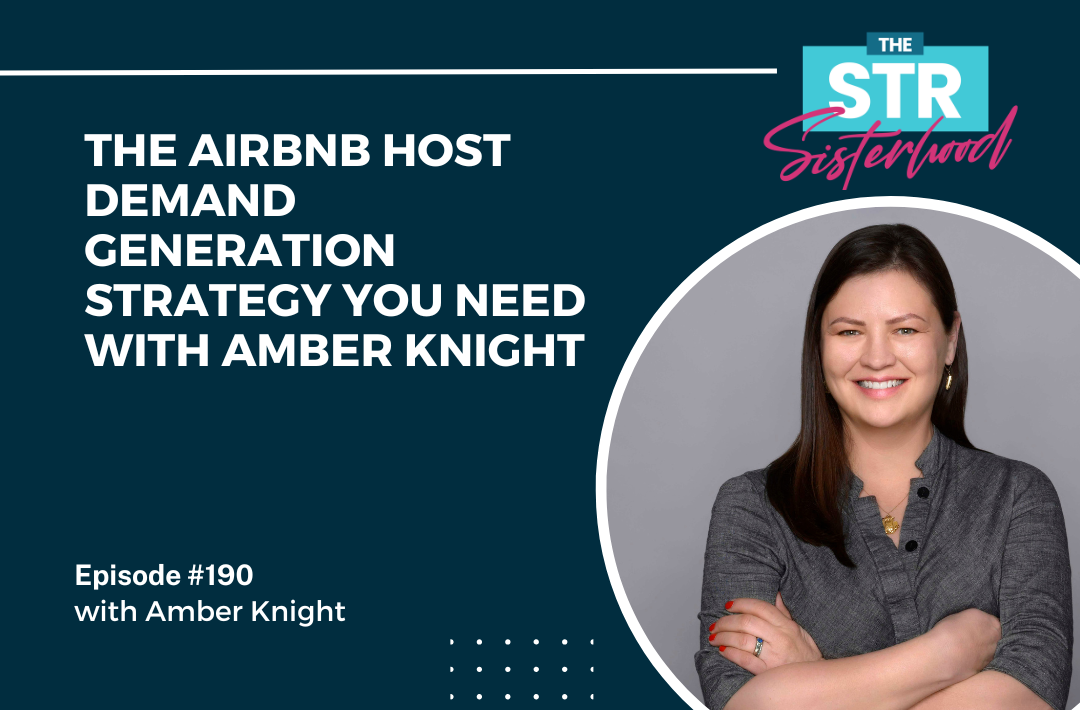
#190 The Airbnb Host Demand Generation Strategy You Need with Amber Knight
Are you truly in control of the demand for your short-term rentals, or have you quietly outsourced it to the OTAs without even realizing it? For years, operators simply uploaded properties to large platforms and waited for the bookings to roll in. But the landscape has shifted. If you want to build a resilient, scalable business, mastering your Airbnb host demand generation is no longer optional.
In our recent podcast episode, I sat down with Amber Knight, the founder of Bookings Cloud. Amber has an extensive history in the vacation rental space, having built growth strategies for Vacasa, Rented, Inhabit, and LiveRez. We unpacked what it really means to build a direct guest acquisition engine for your properties.
Why Your Airbnb Host Demand Generation Must Shift Now
Historically, operators focused almost exclusively on homeowner acquisition, operating under the assumption that demand was unlimited. OTAs offered the easiest and cheapest source of acquiring new guests, prompting short-term rental operators to offload this massive mental load to third-party tech giants.
However, these platforms are now public companies beholden to shareholders. They use the data, photos, and amenity lists you worked hard to compile to make money for themselves. If you are not controlling the narrative of your story and where you get your demand, you effectively do not own your business.
As demand naturally fluctuates and market supply remains high, the operators who actively own their demand generation will be the ones who succeed in this next stage of the industry. Diversifying where you get your bookings from is a critical step in building a resilient, sellable business. A business that is truly sellable does not require the owner to be in the day-to-day operations.
What STR Hosts Can Learn From Legacy Vacation Rentals
When comparing the short-term rental world to the legacy vacation rental space, there are a few key operational differences. In reality, both sides are essentially doing the exact same thing. However, legacy vacation rental management companies have had to focus on marketing and generating their own demand for years. Long before OTAs dominated the market, these legacy operators built their own direct guest acquisition funnels.
On the short-term rental side, many operators own their own properties or run co-hosting models. Because platforms like Airbnb made guest acquisition so effortless initially, many newer hosts never developed the marketing muscle required to drive independent traffic. There are countless lessons short-term rental owners can learn from the legacy vacation rental side regarding sustainable, proactive marketing.
Building Trust Before Driving Traffic
Before you spend a dime on an Airbnb host demand generation strategy, your website must establish trust. A beautiful website means nothing if the checkout process is not geared toward conversions.
I learned this the hard way. I once spent thousands of dollars on a beautiful WordPress site, but sent guests over to a separate software page to check out. Taking people from your website and sending them to a different URL to check out is the biggest way to lose trust with a potential booker. It is incredibly important that you utilize property management software that has a built-in booking engine.
If a random person goes to your website, they need to know someone reliable will be there to take care of them. If they don’t trust your website checkout process, they will simply leave and go book the exact same property on Airbnb.
Leveraging Meta Ads for Your Portfolio
Once your foundation is solid, how do you drive targeted traffic? Amber pointed out that Meta is currently underutilized in the short-term rental space on a property level. While your competitors might be running brand-level ads for homeowner acquisition, very few are running property-specific campaigns for guests.
The days of building your own audience manually are over. You want to feed Meta as much data as possible—your metadata, photos, and content—and let their algorithms find the audience for you.
- Use High-Intent Visuals: Show guests exactly what they are looking for. If they want a pool, make sure you show them a photo with a pool.
- Do Not Include Price: Do not put the nightly price in the ad copy. Feed pricing data over to Meta on the backend so they can match a high-ticket property with someone who can actually pay that rate, but keep it off the creative.
- Automate at Scale: Building individual dynamic ads manually takes hours. Using automation tools like Bookings Cloud allows you to automatically create hundreds of ads instantly based on your existing property data.
While pay-per-click ads on Google can cost dollars per click, Meta clicks can drop to twenty to forty cents.
When Should You Start Investing in Paid Demand?
You might be wondering when it is the right time to start utilizing paid social media strategies. Amber shared that the number of properties you have matters less than your top-line revenue and your profit per unit. If you own the real estate, your margins look very different than if you are simply managing for someone else.
Generally, you want to focus heavily on your guest experience and tight operations for your first ten properties. Once you reach around twenty properties, or approximately two million dollars in booking revenue, guests begin to see you as a trusted, established business. At that scale, you have a solid foundation to focus on improving the quality of your revenue, rather than just scrambling to collect more of it.
Understanding Attribution and Playing the Long Game
When you start investing in your Airbnb host demand generation, measuring immediate success can feel murky. Perfect confidence in tracking costs a lot of money. Privacy laws have fundamentally changed how much data we get back from ad platforms.
Guests rarely book a high-value trip off the very first click on Instagram. They need to check dates, consult their families, and verify the details. Therefore, attribution is now more about influence than direct, last-click tracking.
- Look at Booking Pace: Shift your focus from “how many bookings checked in” to “how many bookings did I create for the future.”
- Invest Consistently: If you are spending less than a thousand dollars a month in ad spend, the results are hard to measure. Two thousand dollars a month is often the sweet spot to give the algorithm enough data to return a solid ROI.
- Treat It Like Retirement: Consider your direct booking strategy almost like your retirement strategy. It builds on itself over time to create an unshakeable, resilient business.
You can’t change what happens to you, but you can change how you respond to it. Instead of letting massive platfo
Click here now to listen to the full podcast.
HIGHLIGHTS AND KEY POINTS:
[01:03] A short introduction about our guests Amber Knight, and journey from growing up around vacation rentals to building a career focused on strengthening local hospitality businesses and destination communities
[04:12] Amber reflects on how intentionally building a life and business through consistent daily actions creates opportunities that once seemed out of reach
[06:10] Amber explains how owning guest demand has become a critical competitive advantage as short-term rental operators can no longer rely solely on OTAs to drive bookings
[10:58] Amber emphasizes that successful demand generation starts with building trust and creating a direct-booking experience that converts website visitors into guests
[18:24] How demand generation moves beyond simply having a trusted website and focuses on actively driving qualified traffic to it
[21:07] Amber breaks down Meta advertising as a layered system—from organic content to fully automated, property-level ads—designed to turn raw property data into targeted demand at scale
[28:15] Amber explains when paid social becomes viable for STR operators based on ad spend consistency and unit economics versus OTA commissions
[30:40] What are the effective Meta ads for STRs rely on high-intent, property-specific visuals and structured data feeding rather than pricing-driven creatives
[33:35] Amber explains that attribution is imperfect and long-term direct booking growth should be measured through influence, pacing, and consistent investment rather than immediate ROAS results
[42:16] The lightning round
Golden Nuggets:
- “It’s really empowering that we each have the ability to build a business around a life that we love.”
- “If every day you make another step to get to the life you want, the career you want, in the place that you want, eventually you’ll get there.”
- “A business that is sellable does not require the owner to be in the day to day.”
- “You can’t change what happens to you, you can change how you respond to it.”
Connect With Our Guest:
Website : www.bookingscloud.com
Instagram : https://www.linkedin.com/company/bookingscloud/
Email : aknight@bookingscloud.com
Did you enjoy the episode? Don’t forget to Subscribe, Rate, Review, Like, and Share!