November 10, 2026
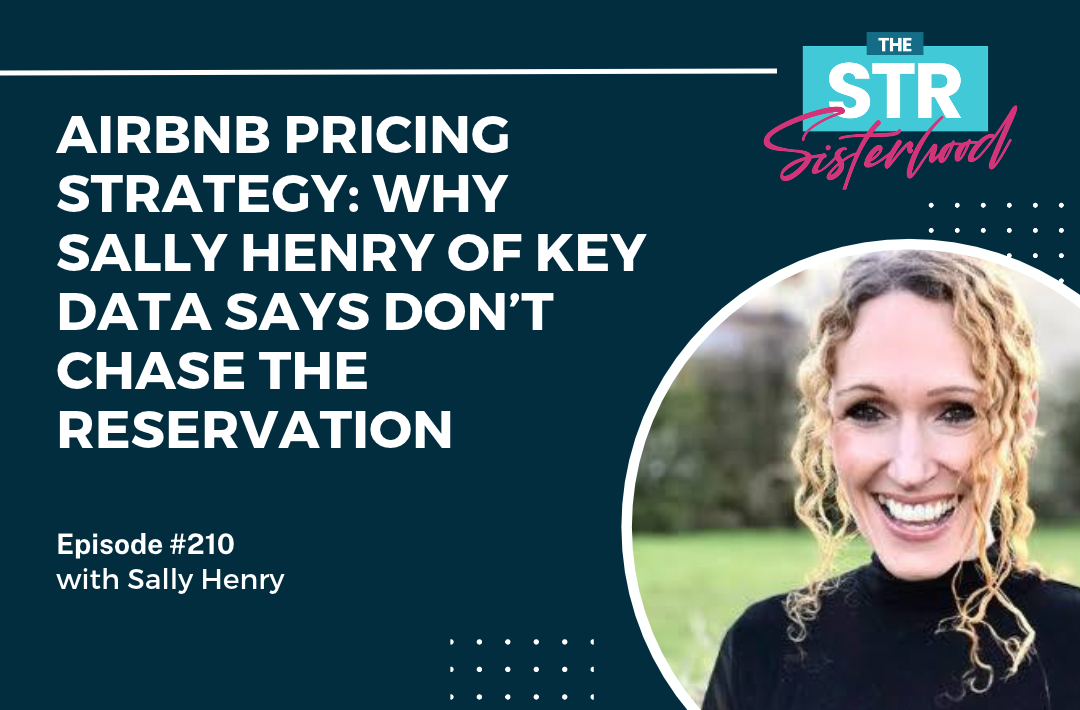
#210 Airbnb Pricing Strategy: Why Sally Henry of Key Data Says Don’t Chase the Reservation
Are you lowering your rates too quickly just because your calendar looks emptier than you’d like? Sally Henry, Vice President of Market Intelligence and Insight at Key Data, says that reflex is exactly what the data warns against, even though 16% of the smallest operators in Key Data’s newest industry report expect rates to decline. If your Airbnb pricing strategy starts with a discount every time a week looks quiet, this conversation will change how you read your calendar.
Sally brings 25 years of industry experience, 19 of them at the world’s largest property manager. Today, she translates Key Data’s market data into insights hosts can actually act on.
And there’s encouraging news. After several challenging years of market readjustment, Sally is seeing what she calls “green shoots,” with both occupancy and rates beginning to move upward.
What Smaller Operators Should Read First in Key Data’s Industry Report
Key Data’s report pulls from operators managing anywhere from under 30 units to more than 500. So I asked Sally what a woman with one property should read first.
Her answer? Absorb it once for the sentiment. Then notice that revenue expectations are rising for 2027, after years of decline while the market absorbed the post-COVID supply surge.
She also pointed out that financial performance and guest satisfaction both rank at the top for owners. Even with one listing, your Airbnb pricing strategy and guest experience need to work together.
Here’s the part most hosts skip. Sally’s real point was mindset: you’re part of an ecosystem. You don’t need a PMS integration to see that. Open the OTAs where you’re listed and look.
If you’re reading your own calendar in isolation, you’re making pricing decisions without context.
Why an Empty Calendar Doesn’t Mean Your Airbnb Pricing Strategy Is Wrong
This is where that 16% number matters. The smallest operators are often the most cautious about rates, and many protect occupancy instead of pushing rate.
Sally’s advice was direct: “Do not automatically go to drop rates as the default.”
Because an unbooked night doesn’t always mean something’s wrong. Sometimes the booking simply hasn’t arrived yet.
How Booking Pace Should Shape Your Airbnb Pricing Strategy
Booking pace depends on property size, geography, length of stay, and guest behavior. Sally explained that smaller properties see a larger share of bookings come in late. That’s normal. A four-plus-bedroom home, on the other hand, should be booking far in advance, because large groups have to plan ahead.
So if your one-bedroom is open three weeks out, that may simply be its pace. Before you touch the rate, check whether your length of stay and start dates fit your area’s guests.
She also named the pressure we all feel from OTAs pushing promotions. But her data showed falling average rates reflect the mix of what’s booked, not a market-wide rate collapse.
“If you’re competitive and you understand the pace, hold your rate.”
Balancing Occupancy and Rate: Chase the Revenue, Not the Reservation
Guests are staying fewer nights. That means more turnovers, more cleans, and higher operating costs per booking.
Discounting into that reality is how revenue quietly erodes.
Sally pointed to RevPAR, or revenue per available rental. It’s your occupancy multiplied by your rate, and the goal is to inch it upward over time. Some of that is testing. Some of it’s gut feel.
Her summary belongs on a sticky note: “Don’t just chase the reservation, chase the revenue.”
What this is really showing you is that a strong Airbnb pricing strategy isn’t a reaction to a quiet week. It’s a decision about what your property needs to earn to operate profitably.
Why Direct-Booking Guests Spend More and Book Earlier
Key Data sees direct-booking guests spend more, stay longer, and book further in advance than OTA guests. Sally recommends using direct channels to secure part of your calendar early, then using the OTAs strategically around it. That channel mix belongs in your Airbnb pricing strategy, not just your marketing plan.
But here’s what surprised even Sally. The OTAs are gaining share in every booking window, including the 60-day to six-month window where most revenue has historically come in.
Why? TV ads, Meta ads, AI investment, and an Airbnb community that books inside an app it trusts. Sally also sees the lowest cancellation rates from Airbnb guests, Vrbo performing better for large properties, and Booking.com gaining ground with small ones.
As Sally put it, “Everyone’s got a place.” Your job is to choose the mix that fits your property.
Turning OTA Guests Into Repeat Direct Bookings
Sally’s advice here is practical and low-cost. Let the OTA be the entry point. Then own the relationship once the guest arrives.
Ask what they enjoyed. Notice they’re traveling with family. Offer help booking dinner or a private chef. Guests who feel that care cancel less, come back more, and it shows up in your 5-star reviews too.
“Your repeat guest has gotta be your goal,” Sally said. From there, build out referrals and friends-and-family bookings.
AI won’t do this part for you. Sally sees AI as a tool for finding gap nights and handling the repetitive work, which is exactly where AI saves STR owners time. The hospitality stays with you. In Sally’s words, “You have to be intentional. It’s not gonna happen by accident.”
How Market Data Takes the Emotion Out of Owner Conversations
If you co-host or manage for owners, listen closely. In Key Data’s survey, 77% named revenue as the most important reason owners stay. Communication came a close second.
Sally’s framing stuck with me. Telling an owner their property is underperforming is like calling their baby ugly. It’s personal. But “the market is dictating this” takes the emotion out of it.
I use Key Data dashboards for exactly this. When an owner asks why we aren’t charging more, I walk them through the data. Sally also shared Key Data’s Owner Lost Income report, which shows what an owner gave up by blocking peak nights.
That’s how an Airbnb pricing strategy becomes something you can defend, not just something you set. It’s also the trust that holds a co-hosting business together.
Already use PriceLabs? Sally positions Key Data as the sense check. An RMS often lowers prices close to arrival, and market data helps you confirm that’s right for your market. If you’re questioning who’s making those calls, start with these five checks for your revenue manager.
The Real Test of Your Airbnb Pricing Strategy
The question isn’t whether your calendar has gaps. Every calendar does. It’s whether you know your property’s normal booking window well enough to wait.
Use the data. Understand your market. Communicate what you’re seeing. Then make the decision that fits your property instead of reacting out of fear.
So ask yourself: When did you last drop a rate because the data told you to, and not because a quiet week made you nervous?
Listen to the full episode with Sally Henry on the STR Sisterhood Podcast. And if you want women around you making these pricing calls with the same clarity, join the STR Sisterhood.
Click here now to listen to the full podcast.
HIGHLIGHTS AND KEY POINTS:
[01:30] A short introduction about our guest Sally Henry, and her role translating Key Data’s market intelligence into actionable insights for property managers
[02:58] Sally shares how a host with only one property can approach a large industry report and why the improving outlook for occupancy, rates, and 2027 revenue expectations matters
[06:16] Why smaller operators can become overly cautious with pricing and how understanding booking pace can prevent hosts from unnecessarily dropping rates too early
[08:18] Sally explains how short-term rental owners can balance competitive pricing with revenue growth using RevPAR and a strategic mix of booking channels
[10:06] How OTA marketing, AI, and traveler loyalty are driving booking behavior across platforms
[10:58] Sally recommends turning OTA guests into repeat direct-booking customers by building relationships and delivering personalized service
[12:28] Sally emphasizes that AI should support market awareness and operational efficiency while owners remain intentional about hospitality
[13:12] Sally identifies revenue optimization and strong owner communication as the top priorities for vacation rental operators
[14:01] How data tools help property managers build owner trust and make objective business decisions
[17:14] What’s next for Key Data, including streamlined dashboards, personalization, APIs, and using AI to help operators move more quickly from information to action
[18:31] The difference between Key Data and revenue management tools like PriceLabs and why market intelligence can serve as a sense check for automated pricing recommendations
Golden Nuggets:
•“Do not automatically go to drop rates as the default.”
• “Don’t just chase the reservation, chase the revenue.”
• “Your repeat guest has gotta be your goal.”
• “You have to be intentional. It’s not gonna happen by accident.”
• “If you’re competitive and you understand the pace, hold your rate.”
Connect With Our Guest:
Website : https://www.keydata.co/ LinkedIn : https://www.linkedin.com/in/sally-henry-3516229/
Full Episode Transcript:
Stacey: Hey friends, we are here with the one and only Sally Henry from Key Data. Thank you so much for being here.
Sally: Oh, thank you for having me. I’m excited to be here.
Stacey: So, why don’t we kick off and have you share a little bit about what you do and what Key Data does for the folks in our industry.
Sally: Of course. So, my name is Sally Henry. I’m from the UK. You’ll probably notice the accent.
Stacey: No way.
Sally: I’ve been in the industry 25 years, but for the last four years, I’ve been at Key Data. I’m vice president of market intelligence and insights. So my key job is to try and take the data that we have and curate it so that it makes sense for the industry and for the property managers. We have all this amazing data, but what does it actually mean, and what’s actionable? I spent 19 years at the largest property manager in the world, and I’m able to try and translate some of the data to what it means for property managers outside.
Stacey: I love that so much. And you know, so many of the folks in my ecosystem are on the smaller side. They’re often managing anywhere from one to 50 properties. And I know everyone has big dreams and big visions and wants to get larger and larger. So I wanted to ask you a few questions about your newest industry report that was just published. Would you mind?
Sally: Of course.
Stacey: And I’d love to look at it through the lens of someone who is early in their career.
Sally: Okay. Yeah.
Stacey: And I’m going to refer to my phone, because there’s so much data in this report. There is no way this brain was going to remember all of it. Okay. So, your respondents for this report range from managing under 30 units to more than 500. If someone, especially a woman, because that is who I’m talking to in my audience, if a woman with just one property picked up this report, what should she be reading first, would you say?
Sally: I think the report’s quite lengthy. When I read it, I was like, you absorb it once to get a general sense check and a feel, right? So if you’ve got one property, you’re potentially doing other things as well. So this is about, how do you take it? The sentiment is about, what’s the feeling for what we’re seeing in the market right now? What are other people doing, and what should you be trying to learn from them, albeit you might not have a team of 100 people that are going to do it?
My biggest sense is the sentiment of it is a more positive vibe than the previous outlook that we had. So I think the first thing I’d be taking away from it is we’re seeing revenue expectations increase for 2027. We’ve had a few years where we’ve seen revenue come down, and we’ve seen occupancy come down as we readjusted post-COVID, when so much supply came in. The market’s been readjusting. So my first sense would be, okay, we’re feeling more positive about the market straight away. I think that would be my starting point, which is good, right?
When I presented the data keynote yesterday on behalf of Key Data, I was able to show that we’ve actually got green shoots. We’re seeing both occupancy and rates pushing up, which is for the first time in a while. So I think I’d be starting off saying, okay, I’m in an industry, and actually, how’s it feeling? Well, it’s positive, right? So that would be my starting point. Okay, we’ve got some green shoots in there.
And then there are some anecdotes that I pulled out around what’s most important, and some of it’s around owner relationships. Now, if you’ve only got one, you kind of think, okay. But there are still some snippets you can pull out to say financial performance is really the most important thing, right? We can’t get away from that. But then if you look at guest satisfaction, it scores really highly for how owners want to make sure that’s represented. So actually, you need to make sure that you take that on board for yourself and say, okay, your guest reviews are so important.
Stacey: And I have owners, sorry to interrupt you, I have owners who are literally checking their own properties every day on Airbnb, Vrbo, and our booking website, and they’re keeping on top of what’s happening with their property.
Sally: 100%. And you know, for Key Data clients, we tend to work with slightly larger operators, because they need to be using a PMS for us to integrate and pull their data in. Not everyone that’s got one property uses a PMS. If they do, you can come through. We revealed quite a lot of data around people being more confident if they’re checking their data every day. But to your point, you can still check your data by going on the OTA where you’re listed and seeing what’s around. What it is, is that mindset to know that you’re part of an ecosystem.
Stacey: So you know what you’re doing. Yeah.
Sally: If markets go over here or that way, you need to sort of know that and be able to respond to it.
Stacey: Absolutely.
Sally: That would be my first takeaway. Some of the headlines we’re talking about, how does that translate to you as a host, and what can you do? I’m sure you’ve got the questions.
Stacey: I’ve got them, so I’m not going to jump ahead. Okay. So, you’ve kind of answered my second question. The smallest operators are sometimes the most cautious about rates.
Sally: Yes.
Stacey: About 16% of the smallest operators expect rates to decline, and your report suggests that they may protect occupancy instead of pushing rates. When is that a smart call, and when does that quietly eat into profit?
Sally: So probably the biggest signs that I would suggest they look out for in the data: understand what pace you’re expecting. If you have a small property, we see a larger percentage of bookings coming in late, right? So that’s a normalization to be expected. You need to understand that. Why that’s important is, if you’ve got a smaller bedroom-size property, the market is later. You don’t need to drop your rates to get that. It’s a later booking pace.
Whereas if you have a large property with four-plus bedrooms, you should be booking out quite far in advance, because that’s very hard to book really late. People have got to be more organized. So it kind of makes sense. It’s about understanding the size of your property, the pace of the market, and your geography. So do not automatically go to drop rates as the default. Sometimes it’s about, have you got the right length of stay or the right start date for the guests that you’re attracting for your area?
We get pressured an awful lot on rates. We have the OTAs going, make sure that you drop your rates and add the promotions, and that helps. What the data shows, that I did on the keynote, and I’ll happily share it with you all, is that actually it’s the portfolio mix of what is booked that’s getting the rates down, not that it’s a rate-drop headline. So it’s about saying, first of all, check: are you competitive? If you’re competitive and you understand the pace, hold your rate. Because actually, people are staying for less, which we’re seeing. You’ve got more operational costs. People have got to clean more. So you’ve got to protect your revenue.
Stacey: Yeah.
Sally: So don’t just chase the reservation. Chase the revenue.
Stacey: Yeah. It’s such an interesting point. You know, I was at Airbnb two weeks ago, and one of the things that folks at the Airbnb corporate offices are sharing is that now, in their own algorithm, the value metric is top bananas, right? And I’m curious, just from your perspective, how does someone balance wanting to be of great value and also maximizing their revenue?
Sally: It’s hard, right? If it was easy, we’d all be doing it. And this is why we have this balance, and we’ve got a metric called RevPAR, revenue per available rental. It sounds a bit scary. It’s revenue. When you multiply your occupancy by your rate, you get your corresponding RevPAR, and you need to be inching that up, right? That’s kind of where we need to get. Some of it is testing, some of it is gut feel.
We see that when people book direct, so directly with a property manager or a host versus an OTA, they spend more, they stay longer, and they book further in advance. So it’s about finding your different channels that can maybe secure part of your calendar and book it up earlier with the type of clients that are willing to commit earlier and spend more. And then you strategically use your OTAs.
But one thing that I saw, which even shocked myself when I was prepping all the keynote data, is that the OTAs are gaining share in every booking window, right? They’ve been exceptional at the late guest, and a lot of people are going, oh, it’s okay, because the OTAs will pick that up for me and fill my calendar late. But direct is losing share in every single booking window. So the more traditional booking window, from about 60 days, two months, to six months, where most of the revenue historically has come in…
Stacey: Right.
Sally: …direct is losing quite significant share to the OTAs.
Stacey: Just from your perspective, what do you think is driving that?
Sally: I think the OTAs are more intentional about trying to bring that in. I don’t think that’s any great surprise, and I don’t think that’s any secret. Let’s think about it. They’re advertising on TV. They have Meta ads. They’ve invested in AI. They understand the search. And if you also look at someone like Airbnb, they have this community that will book on the app. They’re not in the general population going, I want to find a vacation rental, right? They’re very intentional about booking within an app that they feel comfortable with.
Stacey: Right.
Sally: And actually, we see the lowest cancellation rate from Airbnb clients. So it’s about understanding. We see Vrbo books better for large properties. Booking.com’s gaining ground in the small properties. Everyone’s got a place. It’s where you can focus and try and bring in the mix that works for you.
Stacey: So let’s say you’re talking to a smaller operator that has a handful of properties, knowing that there are all these OTAs out there that, candidly, early on, are tremendously helpful in generating bookings on your calendar. But let’s say she really wants to prioritize garnering more direct bookings. What advice would you have for her?
Sally: One thing I’d probably do is treat the OTAs as your original entry point. They’re bringing a guest to your brand, to your property. You can then own them when they arrive, right? And it’s up to you to be intentional about how you talk to them, communicate with them, and build a relationship. Your repeat guest has got to be your goal, right? So speak to them and say, did you enjoy it? What do you like? I understand you’re here with your family. And try and get them, when they’re in that mindset, to rebook. That is in your control.
You don’t have much control until they arrive, unless you get their contact details. But the relationship that they have with you from that booking, as soon as you can get in touch with them, you should be controlling. So if you’re talking to them about, can we help you when you arrive with booking dinner or private chefs, you’re building that relationship. They’re going to be less inclined to cancel, and they’re going to like that service.
Stacey: Yeah.
Sally: So I’d suggest you start there, if nowhere else, because the advertising spend can be quite daunting. Start with that, and then referrals, friends and family. That kind of starts that goal. You have to be intentional. It’s not going to happen by accident.
Stacey: Yes. You know, I always talk about this in my world. I love AI, but I feel like AI to me, outside of ChatGPT and Perplexity, is awareness and intention, right? We have to be aware of our market, aware of what’s going on in our market, and also incredibly intentional about…
Sally: I think AI has its place to help streamline some of those boring operational jobs, like going and finding holes in your data. Okay, we’ve got a gap night, and if you set the right price, the guest buys. But it’s a hospitality environment, in a way. So owning that personality of you and your properties, the guest, that’s in your remit. That’s something you have to own and decide how you’re going to work with.
Stacey: Talk to me about when you look at the state of the industry. What do you see as top priorities for folks who are managing properties, whether they’re small, medium, or large portfolios?
Sally: I think there are probably a couple. Your owners are your starting point, and without your owners, you have nothing. We saw in the report that revenue is the number one driver, right? You have to get your rates right to optimize that, and your occupancy. More revenue, the happier everyone is. And the second, which came really close, is communication. So I think it’s about building your relationship with your owners so that they understand what the market’s doing and they understand what actions you’re taking, whether it’s around pricing…
Stacey: Okay, Sally, you obviously have your finger on the pulse of data from all over the industry. What would you say are the biggest priorities for folks to focus on now?
Sally: Oh, there are so many. But if I had to prioritize one, I think the first one, we all know it’s revenue. How much are you going to make from your property? That’s about getting your occupancy and your rates right. That’s number one. From our survey, 77% said it was the most important thing for why owners would stay. Owners are the lifeblood of any vacation rental business, right? So we need to keep the owners. It’s no great surprise, but revenue, getting that balance, getting your pricing right, optimizing it, and filling in your gap nights, that’s probably where I’d prioritize.
But just straight after that, communication with your owners is the top thing. Effectively building that relationship and that trust with your owners, so that they’re very confident in what you’re doing on their behalf. That you understand the market, that you’re setting the right rates, that you’re reducing length of stay or changing start dates because it’s based on data that they can see and you can share. So I think it’s about that confidence, building the relationship, and keeping the owners informed and happy. That will help you keep your supply intact, which ultimately will help your revenue. If people churn and you’ve got to go and recruit again, that’s expensive. So it all comes back to that core.
Stacey: Yeah. And I’ll tell you from my own personal experience, and she did not pay me to say this, that’s one of the things I love about Key Data. I’ve had owners say, hey, I want to be earning more, why aren’t we charging more? And I can take them through dashboard after dashboard that shows how they’re performing and why I firmly believe we’ve set the right rates. Having the right tools in our toolbox, whether you’re co-hosting or property managing for other people, is so incredibly important.
Sally: I always think with owners, if you tell them their property is like an ugly baby, right?
Stacey: Yeah.
Sally: They get upset, because it’s personal. If you say the market is dictating this, it makes it much less personal. It’s about saying this is the industry’s view, as opposed to saying, I don’t want to stay in your property for seven nights anymore, it’s only worth two. So it really can take some of the emotion out of some of those decisions that you’re making.
Stacey: Absolutely. And it can also help drive conversation. Let’s say you have an owner who doesn’t really want to update their property. You can show how their property is comparing against the up-and-coming properties in the market and really encourage them, with data, to make changes.
Sally: Yeah. And I don’t know if you’ve seen a report in Key Data, which is really cool: Owner Lost Income. So if an owner’s taking loads of nights away, and they’re valuable nights that you want to be selling at peak times, and they go, oh, you’ve not made as much this year as last year, you go, okay, well, let me show you the Owner Lost Income report, which basically works out what they would have got in revenue had you been able to sell it. So some of those just take away some of the emotion again. It’s cold, hard facts.
Stacey: For sure. I have an owner I’m going to show that report to.
Sally: We’ll make sure you find it. Yeah, it’s important.
Stacey: So, Sally, I’m curious. What’s next for Key Data?
Sally: Oh, where are we going? So I think the key thing is…
Stacey: The key thing! Love it, love it, love it.
Sally: We’re doing a few things. We’ve introduced so much into the dashboard, and we know it’s probably got a bit too much for some people, so we’re looking at streamlining a view. The personalization is there anyway, so we’re playing around with that all the time. We’re asking for feedback constantly.
I think the next obvious step is that people are consuming our data in their own environment as well. The API is already live and kicking, but we’re helping productionize that so people can use it in conjunction. We have the dashboards for people that want to see it visually, but we also know people are taking data into their own environments. So we’re facilitating the ability to bring in the data, and then people can choose how they access it.
Stacey: Another thing that I love when I log into Key Data is it has AI insights, right? And it helps feed the actions that we take.
Sally: Absolutely. We’re very aware. I mean, we’ve used AI for years. We process something like 50 million data points a day. We have so much data. But it’s about, how do we help people actually use it, understand the data, and then know what actions they need to take from it? That’s what we need to surface quicker.
Stacey: So I’m curious. If someone is watching or listening and they’re like, well, I have PriceLabs, why do I need Key Data? What would you say?
Sally: We work really closely with PriceLabs. We sit side by side. First of all, our proprietary data set is so rich in the US, so we can go to that next layer of data insights, not just price. We allow you to see where we think you should be taking action. We’ll then suggest you work with your RMS to automate that process, and you come back to Key Data to see whether it’s worked.
So we’re the sense check, and we’ve spoken to an awful lot of people about this. The sense check of, is that action right for your market? An RMS will often trigger lower prices close to arrival to fill in that occupancy. That might not necessarily be correct when you have the nuance of your market data that you can see in Key Data. So we’re not going to change your pricing, but we allow you to contextualize what’s being recommended and sense check that it’s the right thing to do.
Stacey: Love it. Love it. And if anyone wants to find out more about Key Data, where’s the best place for them to find you online?
Sally: Yeah. So keydata.co is our website. It’s literally keydata.co. I’ve not missed anything out. So check us out there. Follow me on LinkedIn, Sally Henry. I’m always sharing market data, but I can connect you with the team, and we can get you set up with a review. There’s so much data out there. We’d love to talk to you.
Stacey: Love it. We could just listen to her talk all day. Is her accent not beautiful?
Sally: Thank you.
Stacey: Thank you so much for being here.
Sally: Thank you so much for having me. I’ve loved it. Have me back on.
Stacey: So good. Thank you.
Did you enjoy the episode? Don’t forget to Subscribe, Rate, Review, Like, and Share!